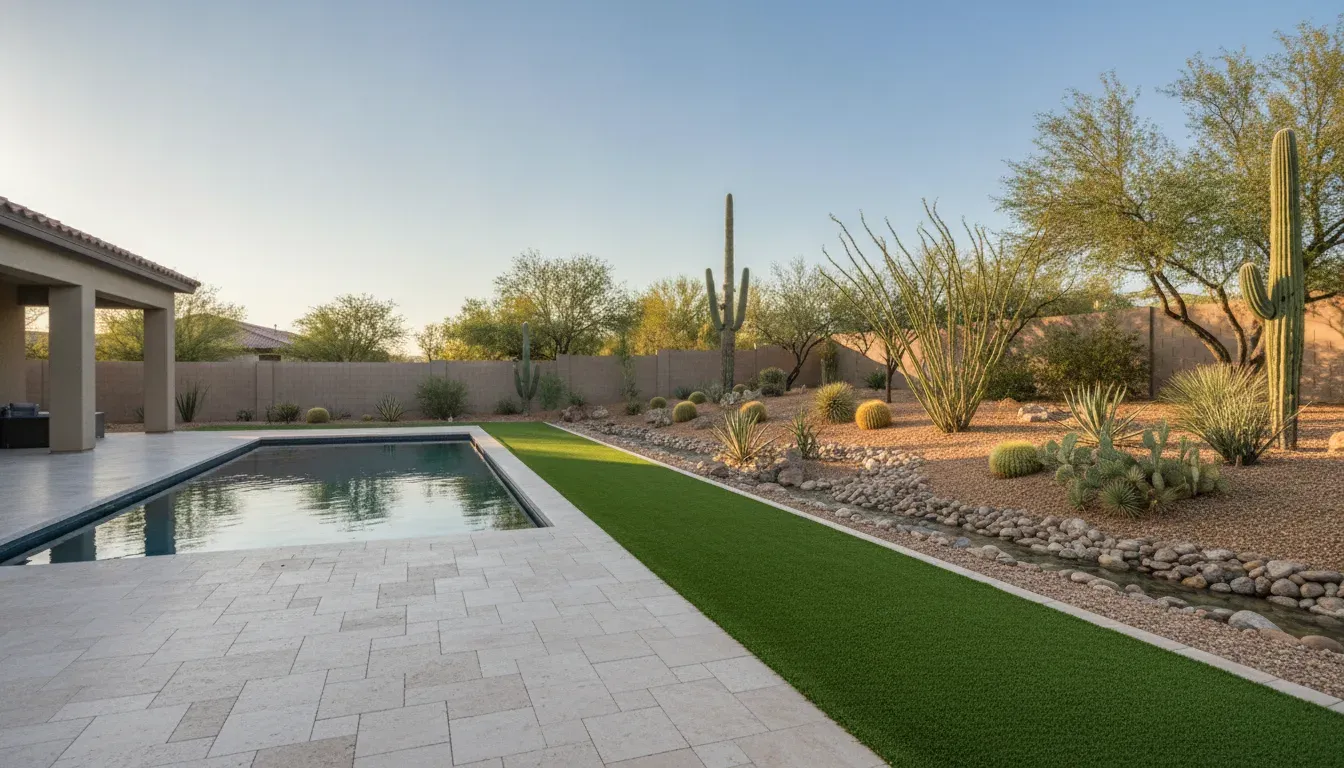
For homeowners researching artificial turf in Phoenix, the most useful question is not simply whether turf belongs in an Arizona backyard. It is where it belongs. Around a pool and patio, the right placement can create a defined lawn, connect activity zones, and soften a hardscape plan without forcing turf into wet-traffic areas or drainage paths.
Book Estimate for your Phoenix backyard plan, or call +1 480 698 8412.
What role should artificial turf play in a Phoenix pool backyard?
Artificial turf in Phoenix works best as one planned surface within a larger outdoor-living layout. It can define a play area, lounge lawn, side-yard connection, or green frame around a patio. The pool deck, walking routes, planting pockets, and turf should be designed together rather than treated as unrelated surfaces.
That distinction matters because a pool backyard has several different jobs. One area needs to support wet feet and frequent access to the water. Another may hold dining furniture or a grill. A third may need to remain open for play, pets, or a visual break between the patio and desert planting. Turf can be useful in the right zone, but it should not be expected to replace every other material.
Modern Pools lists artificial turf and SOD installation within its hardscape and landscape services. The scope can include base preparation, grading and leveling, lawn borders or curbing, and transitions to hardscape. Those details make the project a landscape-planning decision, not just a surface-selection decision. See the artificial turf and pool-ready landscape design service page for the broader service context.
For a complete backyard transformation, turf also needs to relate to shade, seating, cooking, planting, and pool placement. The outdoor living and backyard transformation in Phoenix guide provides the broader planning perspective that helps keep one lawn area from becoming an isolated add-on.
Where can artificial turf in Phoenix fit around a pool and patio?
Artificial turf in Phoenix can fit beside a pool patio, along a side-yard route, around a play space, or between a hardscape and planting bed. The best location depends on circulation, water movement, furniture, sun exposure, and the way the family will use the yard. A simple zone plan helps avoid awkward edges and unnecessary crossings.
1. A defined lawn beside the main pool deck
A turf strip can create visual contrast beside a paver or travertine deck while giving the yard a softer zone for lounging or play. Keep the primary path to the pool clear and direct. If swimmers will cross the lawn constantly, the plan should account for that traffic instead of assuming the turf will remain separate from the wet zone.
The lawn does not need to surround the pool. In many layouts, a defined strip on one side of the deck is easier to use and maintain than a narrow band placed on every edge. The goal is a purposeful outdoor room, not the maximum possible area of green surface.
2. A transition between patio and desert planting
Turf can work as a middle zone between a gathering patio and a desert planting bed. This arrangement creates a clear visual boundary while leaving room for boulders, trees, shrubs, or gravel accents outside the lawn. The edge should be deliberate so irrigation, rock, and plant growth do not blur the line between surfaces.
For ideas on combining a lawn area with planting pockets, deck slopes, and pool-area circulation, review these desert landscaping ideas for an Arizona pool area. The article is a useful companion because it treats the pool yard as a group of connected zones.
3. A side-yard connector
Some Phoenix backyards need a comfortable route from the house or gate to the pool. A narrow turf connector can be part of that plan when its width, edges, and drainage are resolved early. In other cases, pavers or another hard surface may be more appropriate for a high-use route. The answer depends on the actual circulation pattern and the way the space will be used.
4. A play, pet, or putting-green zone
Modern Pools identifies kid play areas, custom putting greens, pet-friendly artificial turf, and dog-friendly systems with improved drainage as possible landscape applications. Those uses require different planning questions. A putting green has different geometry from a play lawn. A dog area may need a dedicated drainage conversation. A family should describe the intended use before the installer recommends a layout.
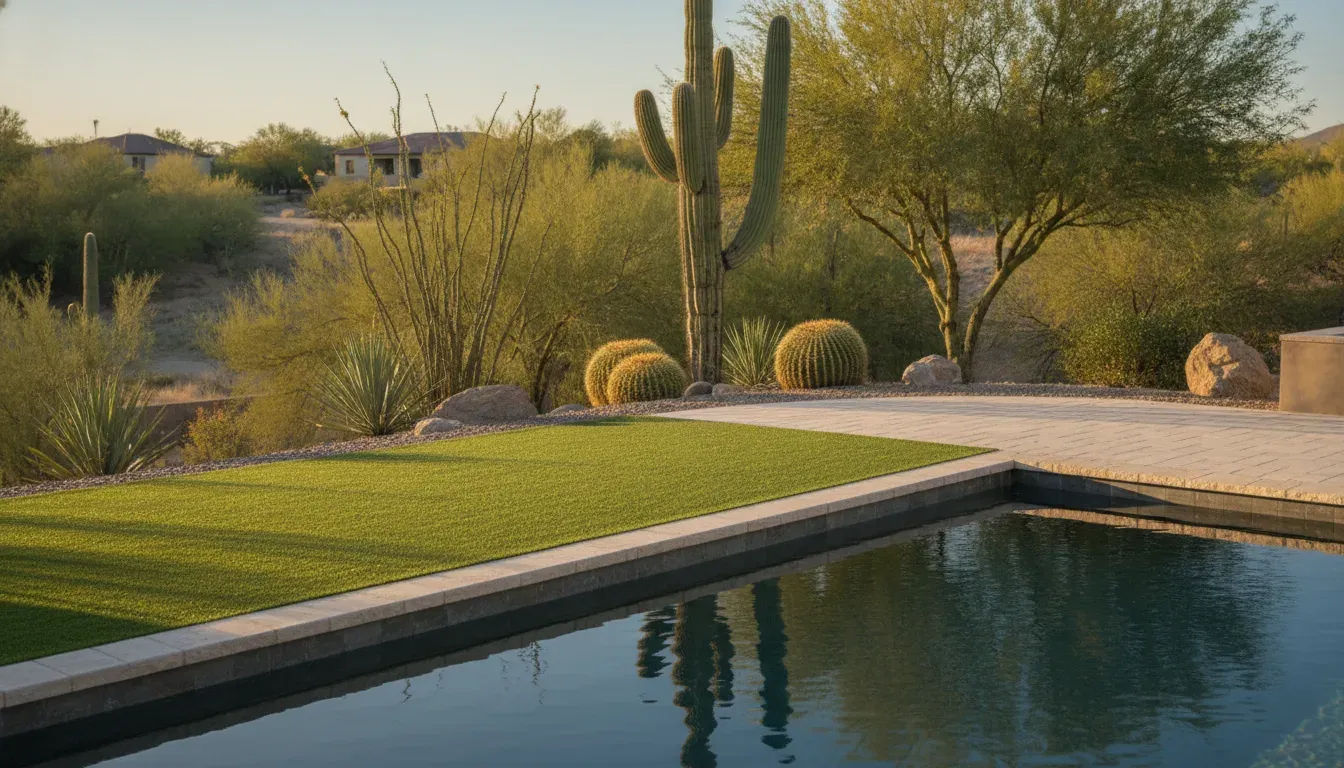
A defined turf area can connect a pool patio to the rest of a Phoenix backyard without replacing every hard surface.
How should artificial turf in Phoenix meet pool decking and patios?
Artificial turf in Phoenix should meet pool decking through a deliberate edge, a stable base, and a transition that supports the intended traffic pattern. The turf edge should not be left to meet coping, pavers, planting soil, or decorative rock by chance. A coordinated detail makes the backyard easier to read and helps each surface perform its intended role.
Ask the designer or installer to show the transition on the plan. Useful points to review include:
- Where the turf edge begins and ends around the pool deck.
- Whether a border, curbing, paver band, or another approved edge is needed.
- How furniture legs, pool gates, steps, and walkways meet the lawn.
- Where decorative rock or planting beds stop so they do not spill into the turf.
- How the finished grades relate to doors, thresholds, drains, and adjacent hardscape.
Hardscape gives the backyard its framework. The guide to backyard hardscape ideas for Phoenix can help homeowners think through patios, paths, walls, planting areas, and the connections between them. If the existing deck needs a material decision, compare travertine vs. pavers for an Arizona pool deck before deciding how the turf edge should meet it.
A clean transition is also a design opportunity. A narrow, consistent border can make the turf look intentional. An irregular edge may be appropriate for a natural planting concept, but it still needs a clear plan. The best detail is the one that matches the backyard's circulation, maintenance approach, and visual style.
What drainage and grading questions matter in Phoenix?
Drainage and grading should be discussed before turf is ordered. Artificial turf in Phoenix does not automatically solve runoff, standing water, or water moving from one surface to another. A site assessment should identify existing grades, low points, door thresholds, pool-deck elevations, and the intended direction of surface water before base preparation begins.
The City of Phoenix residential Grading and Drainage checklist describes how residential plans can address drainage patterns, retention areas, surface improvements, and protective measures for storm runoff. It is not a substitute for a project-specific plan, but it shows why grading belongs in the early conversation, especially when a backyard includes a pool, patio, walls, and landscape surfaces.
Ask these questions during the site review:
- Where does water currently move during irrigation or a storm?
- Will the proposed turf area change the existing flow pattern?
- How will the base be prepared and leveled for the actual site conditions?
- How will the turf meet drains, swales, walls, gates, and hardscape?
- What happens where pool splash, irrigation overspray, or patio runoff reaches the lawn?
- Which parts of the work are included in the landscape scope, and which require coordination with pool construction?
Do not accept a vague promise that a product will fix every drainage concern. Drainage is a site and design issue. The installer should explain the proposed approach in plain language and identify any conditions that need additional review.
Talk with Modern Pools about your pool, patio, and turf layout before the surfaces are finalized.
Which backyard layouts make the most sense?
The right turf layout depends on the role the lawn needs to play. A family that wants a play area may need a larger uninterrupted zone, while a homeowner focused on entertaining may prefer a compact green accent beside the patio. The table below is a planning conversation starter, not a substitute for measuring the property and reviewing grades.
| Layout idea | Where it fits | Planning focus | Watch for |
|---|---|---|---|
| Defined lawn strip | Beside one side of the pool deck | Clear edge, direct pool route, furniture clearance | Making the strip too narrow for its intended use |
| Patio-to-planting transition | Between a gathering patio and a desert bed | Consistent border, irrigation separation, visual balance | Rock or planting material spilling into the turf |
| Side-yard connector | Between the house, gate, patio, and pool | Width, gates, thresholds, and traffic flow | Using turf where a high-use hard path is more practical |
| Play or pet zone | In an open portion of the backyard | Use case, drainage discussion, surrounding edges | Assuming all turf systems have the same features |
A good plan can use more than one surface without feeling disjointed. Repeating an edge detail, aligning a path, or carrying a planting rhythm across the yard can make the pool, patio, turf, and desert landscape read as one design.
For homeowners planning multiple activity zones, the guide to Arizona outdoor-living space design covers circulation, pool access, shade, planting, and outdoor rooms. If cooking and dining are part of the plan, connect the turf discussion with the service page for outdoor kitchens and pergolas in Phoenix.
What should you ask before artificial turf installation?
Before approving an artificial turf scope, ask for a plan that shows the turf area, base preparation, edge condition, nearby hardscape, and relationship to the pool and patio. Artificial turf in Phoenix should be selected after the installer understands how the backyard will be used, where water needs to move, and how the new surface will connect to the rest of the outdoor living design.
- What exact area is included? Ask for dimensions, boundaries, and a clear description of what is excluded.
- How will the base be prepared? The scope should explain grading, leveling, and preparation for the existing site.
- How will edges and transitions be finished? Review curbing, borders, paver bands, coping, planting beds, and gates.
- How will drainage be coordinated? Ask how the proposal relates to current grades, drains, swales, pool splash, and irrigation.
- Which use is the system designed for? State whether the priority is lounging, play, pets, a putting green, or a visual lawn.
- How does this coordinate with pool work? For a new pool or remodel, clarify sequencing and responsibility between the pool, hardscape, and landscape scopes.
- What will the written estimate include? Request clear line items for the planned work and ask which conditions could require a scope change.
These questions help homeowners compare proposals based on scope and planning quality instead of choosing a surface from a small sample alone. Modern Pools approaches pool, hardscape, and landscape work as connected outdoor-living decisions, with owner-involved oversight and 36+ years of combined experience.
Request a clear turf and pool-backyard consultation from Modern Pools before you choose an installation plan.
Frequently Asked Questions About Artificial Turf in Phoenix
Can artificial turf go next to a swimming pool?
Yes, turf can be planned beside a pool, but the location should account for wet traffic, pool access, hardscape transitions, grading, and drainage. It does not need to surround the pool, and a defined lawn zone may work better than a narrow strip on every side.
Should artificial turf replace the pool deck?
Usually, turf and pool decking serve different purposes. A pool deck provides the main hard surface for entry, circulation, furniture, and equipment access. Turf can add a lawn area beside the deck or connect it to other backyard zones when the transition is planned clearly.
Will artificial turf fix a drainage problem?
No product should be treated as a universal drainage fix. The site should be reviewed for existing grades, low points, drains, walls, thresholds, and runoff patterns. Ask the installer to explain the grading and base-preparation approach before work begins.
What should a Phoenix homeowner bring to a turf consultation?
Bring the intended uses for the space, a list of pool or patio changes, pet or play needs, furniture plans, and questions about drainage and transitions. A full address and property-specific site discussion can help the team evaluate the backyard more accurately.
Book Estimate with Modern Pools to plan artificial turf, pool, patio, and landscape elements as one Phoenix East Valley backyard transformation.