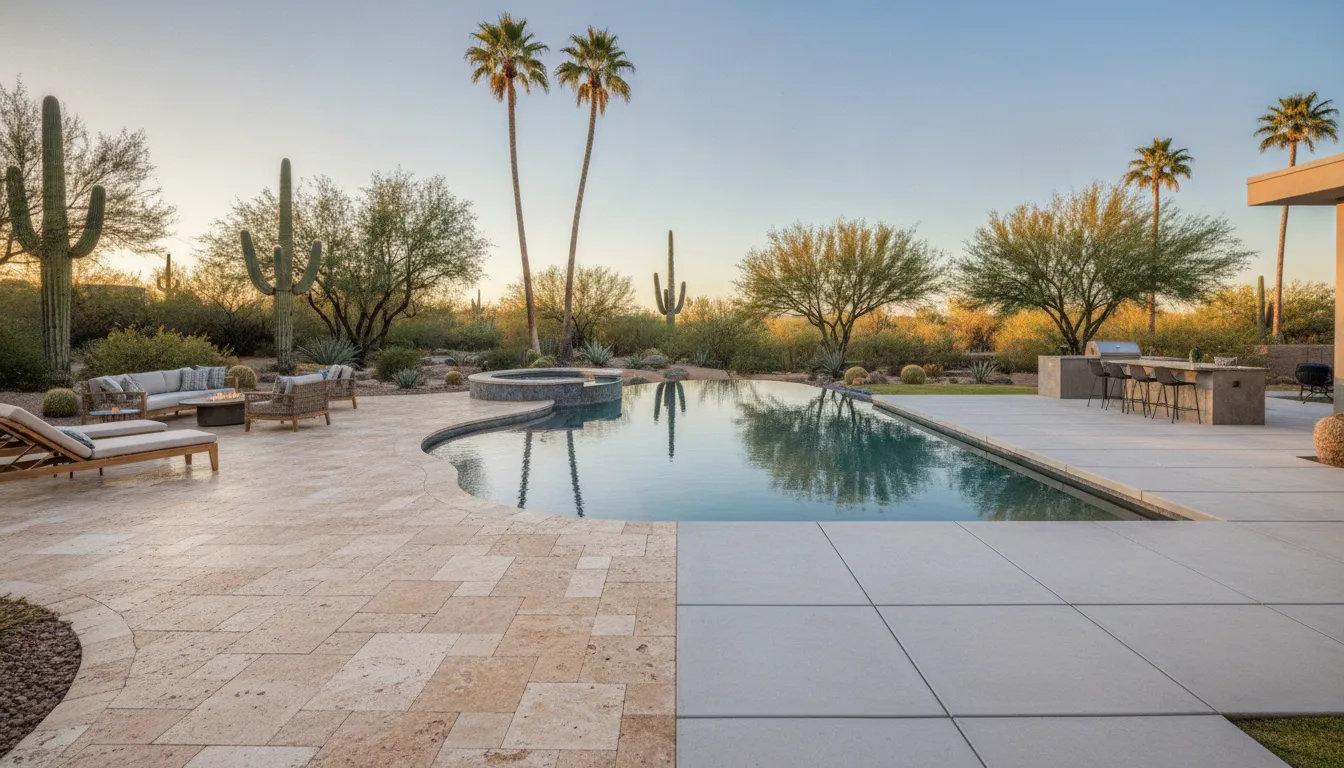
In the Phoenix East Valley, a pool deck has to do more than frame the water. It needs to suit intense sun, wet bare feet, drainage, maintenance expectations, and the way your family uses the backyard. Travertine and concrete pavers can both create a polished, durable setting, but the right choice depends on the specific product, finish, installation, and site conditions.
Book Estimate or call 480-698-8412.
For travertine vs pavers arizona pool deck decisions, there is no universal winner. Travertine offers natural limestone character, warm variation, and multiple finishes, while concrete pavers provide flexible patterns, colors, and repair options. Compare the actual specifications, surface texture, drainage plan, sealing needs, and total design before choosing.
That decision is also part of a larger outdoor living plan. Review Phoenix backyard transformation planning, then weigh how each material supports your pool, landscaping, shade, and entertaining areas as you compare the two surfaces.
Which material is better for an Arizona pool deck: travertine vs pavers?
Short answer: There is no universal winner in the travertine vs pavers arizona pool deck decision. The better fit depends on the look you want, the selected color and finish, drainage needs, maintenance plan, installation details, and the conditions around your pool.
Travertine brings natural variation and a stone-forward appearance. Concrete pavers offer broad design flexibility and can be arranged in interlocking patterns. Both require product-specific review rather than blanket promises about heat, safety, durability, or cost.
Maricopa County's pool design reference recognizes pavers and flagstone among pool-deck materials. Local plan review still matters for the complete project. Review Maricopa County's pool planning reference as part of the design process.
| Decision factor | Travertine | Concrete pavers |
|---|---|---|
| Appearance | Natural limestone with visual variation in texture, veining, and warm neutral tones. | Available in varied colors, shapes, sizes, and styles, including options that resemble natural stone. |
| Layout and drainage | Selection depends on the specific product, finish, installation, and site design. | Interlocking layouts can support flexible design; permeable paving may help stormwater soak into the pavement and soil when the selected system is designed for that use. |
| Maintenance | May require periodic sealing, and acidic substances can dull or etch the stone. | Maintenance and performance depend on the paver product, base preparation, joints, finish, and installation. |
| Arizona comfort | Do not assume a material is cool based on its name alone. Color, finish, shade, and site conditions matter. | Concrete is one paving technology that can be used in cool-pavement approaches, but there is no official universal cool-pavement label. |
For a Phoenix East Valley project, compare actual samples and technical specifications, then coordinate the deck with grading, coping, landscaping, and the rest of the backyard design.
Why do Phoenix homeowners choose travertine for pool decks?
Travertine is a natural sedimentary limestone with a textured surface and warm, earthy coloring. Phoenix homeowners may choose it when they want a pool deck that feels connected to the surrounding landscape and offers more visual variation than a uniform manufactured surface. The right choice still depends on the specific product, finish, installation details, and maintenance plan.
Answer: Travertine appeals to Phoenix homeowners because it combines natural limestone character with varied textures, finishes, and warm neutral tones. Brushed, honed, and tumbled options can create different design effects, but travertine also requires product-specific care, periodic sealing, and attention to pool chemicals.
Natural texture and design variation
Travertine is commonly associated with cream, ivory, brown, rust, and silver tones. Its texture and veining vary from piece to piece, which can give a pool deck a less repetitive appearance. Finishes range from brushed, honed, and tumbled to matte, polished, and glossy. That range makes it possible to coordinate the deck with a modern pool, a more traditional backyard, or a broader outdoor-living plan.
Texture is a design and specification decision, not a guarantee of performance. A smooth or glossy finish will present differently from a brushed or tumbled surface, and the selected product should be reviewed for its intended use. Arizona hardscape and landscape design can also help coordinate travertine with coping, planting, shade structures, and the rest of the backyard.
What should Phoenix homeowners confirm before choosing it?
Travertine needs care around pool chemistry. Acidic substances, including muriatic acid, can dull or etch the stone. Periodic sealing can help preserve its appearance, while the sealer itself should be selected carefully because some products may make the surface slippery. Before approving a material, review the exact technical specifications and manufacturer guidelines for usage, durability, finish, cleaning, and maintenance. Those documents are more reliable than assuming every travertine product performs the same way.
For a complete material comparison, ask for the proposed travertine's product data, finish sample, sealing recommendation, drainage approach, and written scope. That process keeps the visual appeal of natural stone aligned with the practical demands of a Phoenix East Valley pool deck.
What do concrete pavers offer in Arizona pool-deck design?
Concrete pavers can give an Arizona pool deck a flexible, coordinated look through interlocking layouts, varied colors, shapes, and surface formats. They can also be evaluated for drainage needs, including permeable-pavement approaches where site design allows. The right choice depends on the specific product, installation plan, grading, and the rest of the backyard.
Concrete pavers are made for design flexibility. Paving stones can be arranged in interlocking patterns, and manufacturers offer variations in color, shape, and style. Some products mimic the appearance of natural stone, while larger-format units can create a cleaner, more contemporary visual. These options make it easier to connect the pool deck with coping, walkways, patios, and other hardscape elements instead of treating the pool as a separate feature. Belgard describes interlocking patterns and the range of paver formats, but product performance should still be confirmed for the exact system being considered.
How does installation affect the result?
An interlocking layout is only one part of the installation. The base, grading, edge restraint, joints, transitions, and relationship to drainage all need to be planned together. A well-chosen paver pattern can follow curves or define separate zones, but the layout should also support practical movement around steps, equipment areas, seating, and outdoor living features.
What should homeowners ask about drainage?
Permeable pavement is designed to let stormwater move through the pavement and into the soil, which can reduce runoff and filter some pollutants, according to the U.S. Environmental Protection Agency. That does not mean every paver installation is permeable. Ask whether the selected product and base assembly are intended for that use, how water will move across the site, and what maintenance the system requires. Product-specific technical specifications and installation guidance should be reviewed before approval.
Modern Pools offers paver, travertine, porcelain, and stone decking as part of broader Arizona hardscape and landscape design. Coordinating the deck with the pool, planting, shade, kitchen, or pergola can create a more unified backyard transformation.
Book Estimate with Modern Pools or call 480-698-8412 to discuss your pool-deck design.
Which pool-deck surface stays cooler under Arizona sun?
Short answer: Neither travertine nor concrete pavers can be declared the cooler choice in every Phoenix backyard. Surface color, solar reflectance, finish, shade, installation, and site conditions all affect how hot a deck feels. Compare specific products and samples in the planned setting rather than relying on a blanket claim that travertine always stays cooler.
The useful concept is cool-pavement performance. The U.S. Environmental Protection Agency describes cool pavements as materials that reflect more solar energy, support evaporation, or are modified to remain cooler than conventional pavement. However. The EPA also notes that there is no official labeling program that designates a paving material as "cool." Product specifications and the actual design therefore matter more than the material name alone.
- Color and reflectance: Dark surfaces absorb more sunlight. Lighter colors, reflective aggregate, a suitable binder, or a reflective coating can influence solar reflectance. A light paver may perform differently from a dark paver, just as two travertine selections can have different results.
- Texture and finish: A textured, matte, brushed, or tumbled finish may support barefoot comfort and visual character, while a smoother finish can change traction and glare. Review the exact finish, not just the catalog material.
- Wet-foot safety: Pool decks need slip-resistant surfaces for splashes, condensation, and wet feet. Oregon aquatic-facility guidance points to textured finishes and references dynamic coefficient of friction testing. It also warns that insufficient cleaning or inappropriate anti-slip maintenance can contribute to accidents. Use the applicable product guidance and local requirements when selecting a finish.
- Cleaning and chemicals: Keep the surface free of buildup and follow the manufacturer's care instructions. Acidic substances such as muriatic acid can dull or etch travertine, while the wrong sealer can make travertine slippery.
For an East Valley project, evaluate shade patterns, drainage, pool splash zones, and the complete outdoor-living design alongside the sample's color and finish. Modern Pools offers both travertine and paver decking. But the right recommendation should come from the specific product specifications and the way the deck will be used, not an oversimplified temperature promise.
How do maintenance and long-term value compare?
Answer: Long-term value depends less on choosing a universally superior surface and more on matching the material, finish, installation system, and maintenance plan to your backyard. Travertine may require periodic sealing and careful protection from acidic pool chemicals, while pavers depend heavily on proper base preparation, drainage, and product specifications. Clear scope and documented changes matter for either option.
Travertine's natural appearance can remain an asset when it is maintained correctly. Periodic sealing helps preserve the stone's appearance, and an appropriate sealer may improve stain and chemical resistance. However, acidic substances such as muriatic acid can dull or etch travertine, and some sealers can make the surface slippery. The sealer and finish should be selected with wet, bare-foot use in mind, not simply for appearance. Sources recommend reviewing the specific product's technical specifications and maintenance guidelines before installation.
Concrete pavers offer a different lifecycle conversation. Their performance depends on the individual product, the prepared base, joint treatment, drainage plan, and installation quality. A well-designed system should account for movement, water management, and the way the deck connects to the pool, coping, landscape, and other hardscape. Product specifications should confirm intended use and maintenance requirements rather than relying on broad claims about all pavers.
Written scope is part of long-term value, too. Arizona law requires changes, additions, or deletions to specified pool work to be included in a written change order. That documentation helps homeowners understand what is included, what changed, and how the completed deck is expected to perform. It also reduces avoidable surprises when site conditions or design decisions evolve.
Exact Phoenix installation prices depend on scope and are not supplied here. Area, demolition, base preparation, drainage, coping, access, pattern, finish, sealing, and related backyard work can all affect the investment. For maintenance planning, review these pool deck resurfacing options alongside the original material specifications and written project scope.
How should Phoenix East Valley homeowners make the final choice?
Answer: For a travertine vs pavers Arizona pool deck decision, start with how you use the space, then compare finish, maintenance, drainage, and the full project scope. The best material is the one that fits your backyard design and the way your household lives outdoors.
- Define how the deck will be used. Map the areas around the pool, seating, dining, pathways, and future features. A family-focused pool deck may need a practical texture and easy circulation, while an entertainment area may call for a more coordinated pattern and finish. Think beyond the coping and consider how the deck connects to the rest of the backyard.
- Compare heat, color, and finish as a complete system. Do not assume that travertine or concrete pavers is always cooler. Surface color, reflectance, texture, exposure, and installation all affect the experience. EPA notes that cool-pavement performance depends on properties such as solar reflectance and evaporation, and there is no official label that designates a material as cool pavement: EPA guidance on cool pavements. For wet, bare-foot areas, evaluate the specific finish and product specifications.
- Plan the maintenance you will actually perform. Travertine may require periodic sealing, and acidic substances such as muriatic acid can dull or etch it. Ask about the recommended sealer, cleaning method, and chemical exposure for the exact product. For either option, confirm how the finish should be maintained rather than relying on a general material label.
- Review drainage and base preparation. Pool-deck performance depends on grading, base work, joints, and transitions, not just the visible surface. Permeable pavement can allow stormwater to soak into the pavement and soil, but the right drainage approach depends on the site. Maricopa County guidance specifically recognizes pavers or flagstone in swimming pool deck planning.
- Get the complete scope in writing. Coordinate decking with pool construction, landscaping, lighting, kitchens, pergolas, and other outdoor-living elements. Modern Pools offers custom pool construction with whole-backyard planning. Confirm materials, finish, base preparation, drainage, sealing, allowances, and change-order procedures before work begins. Arizona law requires changes to specified work to be included in a written change order.
Ready to compare your pool-deck options? Book an Estimate with Modern Pools at 480-698-8412.
Frequently Asked Questions About Arizona Pool Deck Materials
Which is better for an Arizona pool deck, travertine or concrete pavers?
Neither is the universal winner. Travertine offers natural color variation, textured finishes, and a distinctive stone appearance. Concrete pavers provide broad design flexibility, including multiple colors, shapes, sizes, and interlocking layouts. The better choice depends on your preferred look, finish, drainage plan, maintenance expectations, and the conditions around your pool.
What does travertine cost compared with concrete pavers?
There is no reliable Arizona price without reviewing the complete scope. Material selection, deck size, demolition, base preparation, drainage, access, coping, pattern, installation, and site conditions can all change the total. Ask for an itemized proposal that separates the material, preparation, labor, and related pool work. Arizona law also requires changes to specified work to be documented in a written change order: Arizona Revised Statutes Section 32-1158.01.
What is the best stone for a pool deck?
The best stone is the one that fits the design and performs appropriately for the specific installation. Travertine is a popular option because it is a natural limestone with warm tones and available brushed, honed, or tumbled finishes. Review the selected product's finish, texture, absorption, maintenance requirements, and pool-deck suitability rather than choosing by appearance alone.
What are the downsides of travertine?
Travertine needs periodic sealing, and acidic substances such as muriatic acid can dull or etch the surface. The wrong sealer may also make the material slippery, so product selection and installation details matter. Natural variation in color, texture, and veining can be an advantage visually, but it may not suit homeowners who want a highly uniform deck.
Book an Estimate for Your Arizona Pool Deck
Material selection works best when it considers the pool, surrounding landscape, drainage, finish, and how you want to use the backyard. Modern Pools can help you compare those details as part of a cohesive outdoor-living plan.