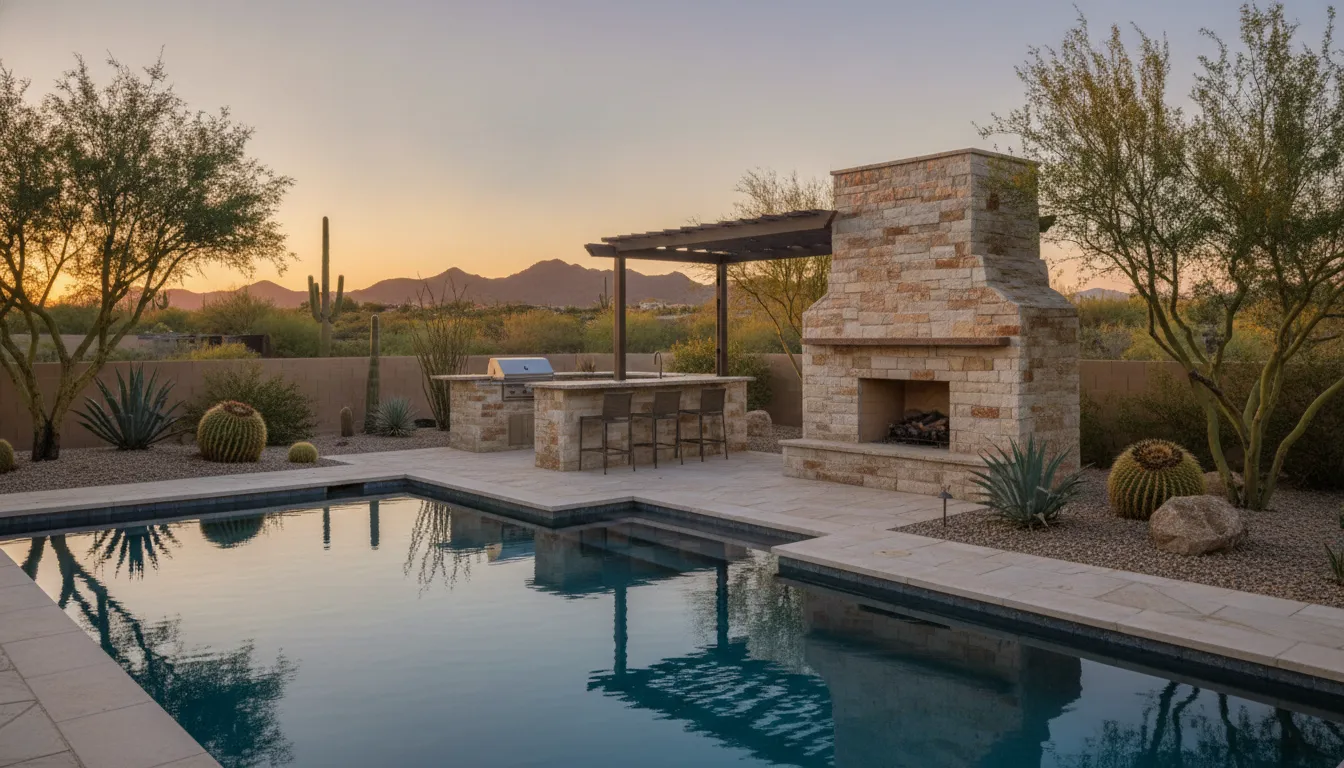
Stone veneer can give a Phoenix backyard the visual weight of natural stone without making every outdoor surface look heavy. Used thoughtfully, it can frame a fireplace, define an outdoor kitchen, add texture to a column, or connect a pool area to desert-adaptive planting. The best stone veneer Phoenix design is not about covering every wall. It is about choosing the right feature, finish, color, and transition for the way the backyard will be used.
Call (480) 698-8412 to book an estimate for your outdoor living design
Where does stone veneer work best in a Phoenix backyard?
Stone veneer is most effective when it gives a useful architectural element a clear visual purpose. It can highlight a focal point, create a transition between materials, or make a freestanding feature feel connected to the rest of the yard. Common applications include:
- Outdoor fireplaces: Veneer can turn a fireplace surround into a focal point for an evening seating area.
- Kitchen islands: A stone-faced island can visually anchor the cooking zone while coordinating with counters and appliances.
- Columns and seat walls: Veneer adds texture to shade structures, privacy elements, planters, and low walls.
- Pool-adjacent accent walls: A carefully placed wall can connect the pool, deck, and landscape without competing with the water.
- Transitions: Veneer can bridge a home exterior, pergola, patio, and planting bed when colors and joints are planned together.
The finish should support the architecture and the maintenance plan. A large, heavily textured profile may suit a rustic or desert-inspired setting, while a more restrained profile can fit a modern home. Looking at the veneer as one part of a complete outdoor living and backyard transformation helps prevent a feature from feeling added on later.
How can stone veneer frame an outdoor fireplace?
An outdoor fireplace is often the strongest candidate for a stone veneer application because it naturally creates a gathering point. The veneer can emphasize the height of the fireplace, soften a large rectangular mass, or echo stone details elsewhere in the yard. The goal is proportion, not simply more material.
Before selecting a profile, review the fireplace size, viewing angles, hearth design, cap or mantel, and the relationship to nearby seating. A narrow fireplace may need a quieter pattern so the surface does not feel busy. A broad fireplace wall may support larger-scale stone, horizontal lines, or a contrasting band. Keep the pool sightline in mind, too: a fireplace should frame the backyard experience rather than block it.
Fire features also require careful coordination among the structure, firebox, clearances, finish system, and installation details. The veneer should be selected and installed according to the specific product and the feature's construction requirements. Avoid treating a decorative sample as proof that a product is appropriate for every heat-exposed application.
Can stone veneer improve an outdoor kitchen design?
Yes, when the veneer supports the kitchen's layout instead of distracting from it. An island face is usually more successful when the base, countertop, appliance doors, and surrounding hardscape feel intentional together. Plan the working side and the guest-facing side separately: the cooking side needs access to utilities and service areas, while the outward-facing side carries much of the visual character.
For Phoenix outdoor kitchens, review exposure to sun, dust, monsoon weather, food spills, irrigation spray, and pool chemicals. These conditions do not make one universal material choice correct, but they do make product specifications and cleaning guidance important. Ask how the selected veneer should be cleaned, whether it needs sealing, and how repairs would be handled if a piece is damaged.
Stone veneer can also help an island relate to a pergola, pool deck, or retaining wall. Compare the veneer sample beside the actual counter material and paving samples, not under showroom lighting alone. Modern Pools' Phoenix outdoor kitchen and pergola planning service can coordinate cooking, shade, landscape, and hardscape as one plan.
Which walls, columns, and transitions deserve a stone finish?
Not every vertical surface needs veneer. The strongest candidates usually have a job in the plan: they retain soil, define a room, screen a view, support shade, frame a fireplace, or guide movement through the yard.
| Feature | Why veneer can work | What to review first |
|---|---|---|
| Fireplace surround | Creates a focal point and gives the gathering area a grounded finish. | Fireplace construction, clearances, scale, hearth, and heat-exposure requirements. |
| Outdoor kitchen island | Defines the cooking zone and coordinates the island with the rest of the yard. | Counter overhang, appliance access, utility routing, cleaning, and splash exposure. |
| Seat or planter wall | Adds texture while helping organize seating, planting, or grade changes. | Drainage, cap detail, seating comfort, irrigation, and adjacent paving. |
| Pergola column | Gives a shade structure a more substantial architectural base. | Column proportions, structural finish, visual weight, and transitions to the patio. |
| Pool accent wall | Connects the pool environment to landscape or an outdoor room. | Water exposure, splash zone, coping, drainage, and sightlines. |
For broader hardscape decisions, compare the role of stone veneer with pavers, travertine, porcelain, concrete, and planting. The Phoenix hardscape and landscape design service describes how decking, walls, planting, irrigation, and lighting can be coordinated instead of selected as isolated samples.
Book an estimate to review stone veneer options for your Phoenix backyard
How should stone veneer transition into pool decking and landscape?
A successful transition repeats a deliberate idea without making every surface identical. That might mean carrying a warm neutral from the fireplace into a planter cap, repeating a subtle gray in the pool coping and veneer, or using a shared joint line between a wall and patio. It does not mean matching every color exactly.
Pay attention to the points where people move and where water travels. Veneer near a pool should meet coping and decking with a clear, durable detail. A wall near planting should account for irrigation spray, drainage, soil, and root growth. A veneer column at a pergola should meet the patio cleanly and maintain comfortable circulation around dining or lounge furniture.
Use full-size samples when possible. Small samples can hide variation in color, texture, and joint appearance. Review them in bright sun, afternoon shade, and evening lighting. The backyard hardscape ideas for Phoenix guide can help compare walls, paving, shade, and other outdoor-living elements before one finish dominates the plan.
What should Phoenix homeowners ask about heat, water, and maintenance?
Phoenix conditions make maintenance planning part of the design, not an afterthought. Ask these questions before approving the material:
- Is the exact product rated for the intended exterior application?
- What installation system, substrate preparation, flashing, drainage, and joints does the manufacturer require?
- How should the surface be cleaned after dust, food spills, irrigation minerals, or pool splash?
- Does the product or sealer need periodic maintenance, and what products should be avoided?
- How will the feature handle water at its base, cap, corners, and transitions to paving?
- Can a damaged piece be replaced without rebuilding the entire feature?
Do not assume that a darker color, rough texture, or product labeled for exterior use tells the whole story. Surface temperature, shade, exposure, finish, installation, and surrounding materials all affect how a feature performs and feels. For the landscape around the veneer, the City of Phoenix desert landscape guidance is a useful reference for water-conscious planting decisions. Irrigation and planting should be planned so they support the feature rather than constantly wetting it.
How can stone veneer fit different Phoenix East Valley styles?
The same material family can look very different depending on scale, grout or mortar color, pattern, cap details, and what surrounds it.
- Scottsdale: A restrained stone palette can complement clean architectural lines and larger shaded entertaining areas. See the Scottsdale pool-builder service area for the broader local planning context.
- Chandler: A fireplace or kitchen island can connect the pool to a structured patio and family gathering zone. The Arizona outdoor living space design guide covers how rooms and circulation shape the plan.
- Mesa: Stone veneer can add a focal point to a larger yard when paired with practical planting, paths, and shade.
- Tempe: A smaller accent wall, column, or kitchen base may provide texture without overwhelming a compact outdoor room.
Local style should not replace site-specific planning. Confirm HOA requirements, access, utilities, grading, drainage, and the relationship to the existing home before finalizing a finish. Modern Pools serves Phoenix and the East Valley with coordinated outdoor-living design and construction planning.
What is the best way to plan a stone veneer feature?
Start with the backyard use case, then choose the feature. If the family gathers around a fire, prioritize the fireplace and seating relationship. If entertaining centers on cooking, begin with the kitchen workflow and let the island finish support it. If the pool and landscape feel disconnected, use a wall, column, or planter as a transition rather than adding veneer randomly.
Bring the home exterior, pool coping, deck, landscape, shade, lighting, and any existing masonry into the same conversation. A coordinated plan can also reveal where veneer is unnecessary, which may keep the design cleaner and easier to maintain. For projects that combine multiple elements, the outdoor living space planning guide and Arizona outdoor kitchen design ideas provide useful starting points.
During an estimate, ask for material samples, a clear scope, installation assumptions, maintenance guidance, and how the veneer will meet adjacent surfaces. Transparent planning is more useful than choosing a finish from a single photograph.
Talk with Modern Pools about a coordinated Phoenix outdoor living plan
How Do Natural and Manufactured Stone Veneer Differ?
Natural stone veneer is quarried stone cut to a facing thickness. Manufactured stone veneer is concrete cast from a stone mold and colored with pigment. Both are finishes. Neither one holds the roof, retains a slope, or waterproofs the wall behind it.
Pick the type for the exposure. Natural mineral color stays steadier on a south or west wall in Phoenix sun. Manufactured pigment can soften over years on that same face, but the units are lighter and often come with matched corner pieces. A shaded column or a kitchen base may value those corners more than mineral color.
Repair is the other split. A natural piece is easier to match later if the quarry source is still sold. A manufactured profile is harder to match if that run is discontinued. Ask the supplier which outcome fits the feature before the sample is approved.
The Concrete Masonry and Hardscapes Association publishes clearance checkpoints for manufactured stone veneer. On a framed wall, it calls for at least 4 inches of clearance from grade and at least 2 inches above a patio. Do not bury that gap to make the base look grounded. Soil and sprinkler spray are common reasons the first course stains. See the list in CMHA's manufactured stone veneer checkpoints.
What Should You Confirm Before the Veneer Is Ordered?
Bring the placement decision to the estimate in a short sequence. The order keeps the stone from being asked to do a job it cannot do.
- Name the feature first: fireplace, column, kitchen base, accent wall, or transition.
- Confirm the backup is structural and the veneer is only a facing.
- Mark where water leaves at the base, and keep that line above soil and paving.
- Check corner pieces, a sloped cap, and any firebox rating before the profile is locked.
- Point irrigation at plants, not at the finished stone, after the landscape goes in.
Modern Pools does not publish a per-square-foot veneer price. Yard stone, corners, caps, and the wall behind the face all move the number. A consultation prices the faces in your plan. It does not treat a supplier yard price as an installed backyard price.
If the yard also needs a new pool, the veneer should be drawn with the water, the deck, and the cover. Start that conversation with custom pool and spa builds so the stone is not added after the grades are set.
Frequently Asked Questions About Stone Veneer
Is stone veneer a good choice for Phoenix outdoor living?
It can be a strong choice for focal features such as fireplaces, kitchen islands, columns, planter walls, and pool-adjacent accent walls. The right result depends on the specific product, installation system, exposure, drainage, maintenance plan, and how the finish relates to the rest of the backyard.
Does stone veneer make an outdoor space cooler?
Do not treat stone veneer as a guaranteed cooling solution. Shade, orientation, color, finish, airflow, surrounding hardscape, and planting all affect comfort. Choose the feature and finish for the overall design, then review product-specific performance information.
Does exterior stone veneer need sealing?
Some products or applications may call for sealing, while others have different care requirements. Follow the manufacturer's instructions for the exact veneer and installation. Ask how sealing affects appearance, cleaning, water behavior, and future maintenance.
Can stone veneer be used around an outdoor kitchen?
It can be used on an island or other kitchen feature when the selected product and installation are appropriate for the exposure. Plan for heat, food spills, irrigation, pool splash, cleaning, appliance access, utilities, and repairs before choosing the finish.
Should every wall in a Phoenix backyard use stone veneer?
No. Veneer usually works best when it emphasizes a feature or transition. Using it selectively can create hierarchy and keep the backyard from feeling visually heavy. Pair it with suitable decking, concrete, planting, lighting, and shade elements.
Call (480) 698-8412 or use the form. Arizona ROC 357795 KA-5.
Call (480) 698-8412 to plan your Phoenix stone veneer feature