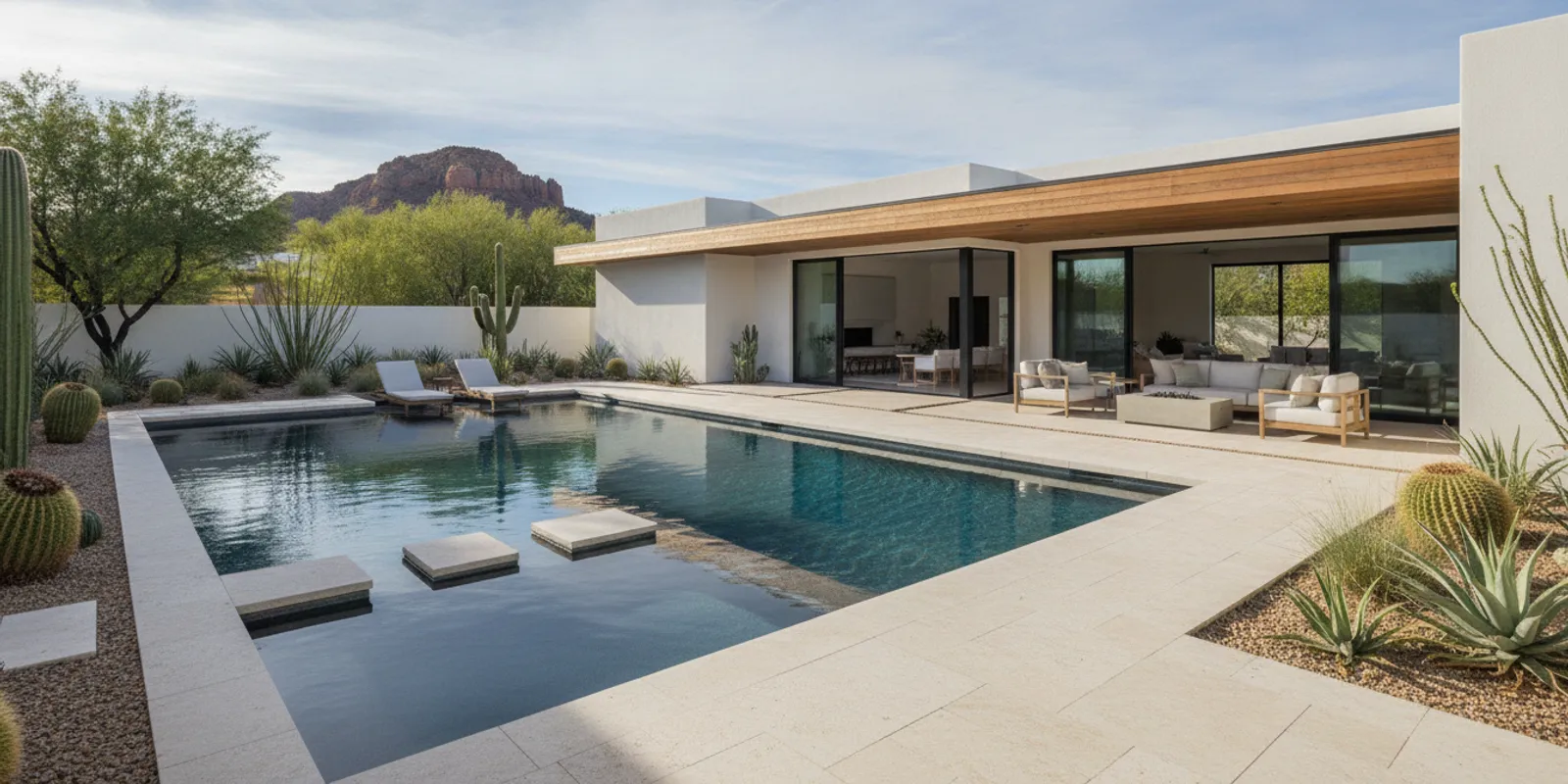
How much value does a pool add to a home in Arizona? There is no reliable fixed amount or percentage that applies to every property. A pool may make a home more appealing to buyers who want outdoor living in the Phoenix climate, while other buyers may weigh upkeep, safety, and operating responsibilities more heavily. The impact depends on the home, neighborhood, pool condition, and likely buyer.
Why is there no single pool value increase for Arizona homes?
A pool is one feature in a larger home purchase. Its contribution to a sale price depends on what buyers in that specific market value and what comparable homes offer. A feature that helps one property stand out may not produce the same response in another neighborhood.
Research does not provide a universal Arizona formula. A study on recreation amenities and home valuation in Southern Arizona examines the contribution of bundled amenities, rather than establishing a guaranteed premium for every pool. It is a useful reminder that amenities are evaluated in context, not as an automatic dollar-for-dollar return. Read the Southern Arizona recreation-amenities study.
For a practical estimate, consider the local market and the whole property, not just the cost of construction. A real estate professional familiar with recent comparable sales can help assess how similar homes with and without pools are performing. An appraiser can provide a property-specific opinion; neither can promise a particular future sale price.
Which factors can shape a pool’s appeal to buyers?
In the Phoenix East Valley, many households value outdoor space, but preferences vary. A pool is more likely to support buyer appeal when it feels like a coherent part of the backyard and is in good working condition.
- Buyer fit: Families, entertainers, and people seeking a resort-like outdoor area may see the pool as a benefit. Buyers who do not want maintenance may see it differently.
- Condition: A clean, functional pool presents differently from one with visible wear, equipment concerns, or deferred repairs.
- Design and integration: Proportion, circulation, shade, landscaping, and usable deck space affect how the entire yard works.
- Operating expectations: Buyers may ask about routine care, equipment, water use, and safety responsibilities.
- Neighborhood context: Local buyer preferences and comparable listings matter more than broad claims about statewide value.
Thinking about a new build? Compare pool package inclusions and consider how features fit your plans, rather than assuming that every upgrade increases resale value.
Does pool quality matter more than size?
Size alone does not tell the whole story. A large pool that overwhelms a compact yard can leave little room for seating or movement. A smaller design may suit the lot better and leave space for shade, planting, or an outdoor dining area.
Focus on usability and condition:
- Choose a layout that fits the yard and supports how you expect to use it.
- Plan circulation between the house, pool, and seating areas.
- Consider shade and desert-appropriate landscaping as part of the whole outdoor space.
- Discuss equipment access, controls, lighting, and maintenance needs before finalizing a design.
- Keep project documentation and service information for future owners.
Modern Pools provides custom pool construction and outdoor living solutions with owner-involved oversight. Its published package prices include a Basic Pool Package at $37,999 and an Oasis Pool & Landscape Package at $51,999, both plus permits and taxes; Serenity and Resort packages are custom-priced. These are project prices, not predictions of added home value. Review the Arizona custom pool cost guide and the pool and outdoor living services to understand the available scope.
How can upkeep affect the decision?
A buyer may appreciate a pool and still want clear information about its condition and care. Regular upkeep helps preserve usability, while neglected surfaces or equipment can create questions during a sale. Actual maintenance needs vary with the pool, equipment, use, and conditions.
Before listing, homeowners can organize:
- Recent maintenance and repair records, if available.
- Equipment details and operating instructions.
- Information about known issues and work completed.
- Relevant permit or project documents that were provided during construction.
A pool inspection or qualified professional’s assessment can help identify concerns to address or disclose. Avoid treating a remodel as a guaranteed value strategy; first determine whether the work solves a real condition or usability issue. For a decision framework, see how to weigh a pool remodel against replacement.
How should you compare the possible benefits and trade-offs?
Use the table as a planning tool, not as a price forecast. The value side depends on the property and buyers; the trade-off side reflects responsibilities that should be considered before building or selling.
| Factor | Potential benefit | Question to weigh |
|---|---|---|
| Outdoor lifestyle | Creates space for swimming, relaxing, and entertaining at home. | Will you use it enough to justify its care and operating needs? |
| Buyer appeal | May attract buyers looking for a pool and outdoor living. | Do comparable homes and likely buyers in your area value pools? |
| Backyard design | Can anchor a complete outdoor environment when well integrated. | Does the plan leave usable space for shade, seating, and circulation? |
| Condition | A cared-for pool can be easier to understand and evaluate. | Are equipment, surfaces, and records in order? |
| Ownership responsibilities | Provides a private amenity for the household. | Are ongoing care, safety, and operating responsibilities acceptable? |
What should you check before building with resale in mind?
Start with your own use. If you expect to enjoy the pool for years, its lifestyle value may matter even when future resale effects are uncertain. If resale is the main reason for building, speak with a local real estate professional before committing to a design or upgrade.
- Study comparable properties. Look at recent homes in your neighborhood with similar size, condition, and outdoor features. Ask a real estate professional how buyers have responded.
- Set a complete project scope. Include the pool and related yard elements you actually want. Modern Pools publishes package prices; permits and taxes are additional, and custom packages are priced to scope.
- Design for the lot. Consider sun exposure, shade, privacy, access, and how the pool connects with the home.
- Confirm local requirements. Permitting and HOA review can affect planning. Review the Arizona pool permit guide and confirm the requirements that apply to your property.
- Plan for ownership. Understand equipment operation, routine care, and safety measures before construction begins.
To prepare for a project conversation, see what to prepare for a pool estimate visit and browse the project gallery for design ideas.
How can you assess value without relying on a guess?
Separate three questions that are easy to blur together: what the pool cost to build, how much you personally value using it, and how a future buyer may respond. The construction price is known from the project scope; personal enjoyment is a household judgment; resale impact must be assessed from local evidence. None of those figures automatically determines the others.
For a more grounded view, ask a local real estate professional to compare homes that are genuinely similar in location, lot size, interior condition, and outdoor features. A comparison between a renovated home with a pool and a smaller, dated home without one will not isolate the pool’s contribution. Ask what differences can reasonably be attributed to the amenity and what other features may explain the sale prices.
Also consider the timing and condition of the evidence. A few listings are not the same as completed sales, and asking prices do not show what a buyer ultimately paid. If there are too few close comparisons, the responsible answer may be that the market signal is unclear. An appraiser can explain how a property-specific valuation is approached, while a builder can clarify design, scope, and construction choices.
When speaking with professionals, bring practical questions: Are pool homes selling faster, or simply attracting a different group of buyers? Do buyers expect a particular condition or a usable yard around the pool? Are there concerns about repairs, equipment, or documentation? These questions help turn a vague claim about value into a more useful discussion about your property and plans.
What should a homeowner weigh beyond resale?
Resale is only one part of ownership. If you are deciding whether to build, consider how the pool fits your daily life, the yard, and your longer-term plans. A household that expects frequent use may judge the project differently from one planning to move soon. Neither perspective is automatically right; the key is to make the trade-offs explicit.
- Use and enjoyment: Think about who will use the pool, when, and how often. Consider whether the design supports swimming, relaxation, entertaining, or a mix.
- Space: A pool uses part of the yard. Decide whether there will still be room for seating, shade, play, planting, or other outdoor activities you value.
- Care and operation: Understand the routine attention, equipment operation, and ongoing expenses associated with the pool you are considering. Ask questions specific to the proposed design rather than relying on a broad estimate.
- Safety responsibilities: A pool requires thoughtful household practices and attention to applicable local requirements. Include safety planning in the design conversation, not as an afterthought.
- Time horizon: If you may sell soon, ask local professionals about current buyer expectations. If you plan to stay, give appropriate weight to years of personal use.
This broader view can prevent a common mistake: treating the project as a simple financial calculation. A pool can be a worthwhile backyard transformation for a household even when its precise contribution to a later sale cannot be predicted. Conversely, a buyer’s enthusiasm for pools does not make an unsuitable design or poorly maintained feature a sound choice.
How do location and outdoor layout influence buyer fit?
Arizona is not one uniform housing market. Buyer expectations can vary between neighborhoods and even between homes with different lot sizes and outdoor layouts. Phoenix East Valley homeowners should look closely at nearby properties rather than assuming that a statewide rule applies in Scottsdale, Chandler, Mesa, or Tempe alike.
Outdoor usability also comes from more than the water itself. Shade, circulation, seating, planting, and the connection between the home and pool can make the yard feel cohesive. A pool that leaves no practical space to gather may not serve the same needs as one integrated with a comfortable patio and clear movement paths. The goal is not to add every possible feature; it is to make the space work for its users and property.
Think through the yard in zones. Where will people enter and leave the pool? Is there a place to sit in shade? Can guests move between the house and outdoor dining without crossing awkward areas? Does the layout preserve privacy and access for maintenance? These practical choices influence how the space functions today and how easily a future buyer can understand it.
For inspiration, review Arizona backyard ideas for a more usable pool area and pool design considerations for Arizona’s climate. Use ideas as starting points, then adapt them to your lot, household, and project scope.
How should you prepare a pool for a future sale?
If a move is on the horizon, focus first on clear presentation and accurate information rather than assuming a large renovation is necessary. A buyer can better assess a pool when it is clean, accessible, and supported by straightforward records. Addressing a known issue may reduce uncertainty, but the right scope depends on the actual condition and advice from qualified professionals.
- Review condition: Note visible wear, unusual operation, or repair needs. Arrange a professional assessment if you are unsure what a concern means.
- Organize records: Gather available service notes, equipment instructions, permits, and project information. Do not claim work or approvals that you cannot verify.
- Make the space legible: Clear the deck, show how the pool area connects to the house, and present usable seating or shade if already part of the yard.
- Discuss disclosure: Ask your real estate professional what information must be disclosed and how to present known conditions accurately.
- Compare work options: If repairs or remodeling are being considered, weigh the scope against the property’s needs and local market advice. Do not assume each improvement will be recovered at sale.
For an older pool, the decision may involve repair, renovation, or replacement. A measured assessment is more helpful than starting with a resale promise; compare remodel and replacement considerations before choosing a direction.
Frequently asked questions about pool value in Arizona
Does a pool always increase a home’s resale price?
No. There is no guaranteed increase. The result depends on local comparable sales, property condition, buyer preferences, and how the pool fits the home.
Can a pool make a home harder to sell?
It can narrow the pool of interested buyers if some prefer not to take on maintenance or safety responsibilities. Other buyers may specifically seek a pool, so local demand and presentation matter.
Should I remodel a pool before selling?
Not automatically. First assess its condition and compare the likely cost and purpose of the work with advice from local real estate and pool professionals. A remodel should not be treated as a guaranteed return.
How can I estimate what a pool might mean for my property?
Review comparable sales with a local real estate professional and, when appropriate, seek an appraiser’s property-specific opinion. A builder can discuss design and project scope, but cannot guarantee resale value.
Contact Modern Pools to discuss your backyard plans
Get a quote for your pool project
A well-planned pool can be a meaningful lifestyle feature, but its effect on a future sale is specific to the property and market. Make the decision around your household’s needs, a realistic project scope, and informed local advice.