Choosing a pergola company is about more than selecting a style. Phoenix homeowners should compare the design, shade needs, materials, installation scope, permit responsibilities, and communication plan before signing. This checklist can help you assess proposals and decide whether a pergola fits the way you want to use your backyard.
What should a pergola do in your backyard?
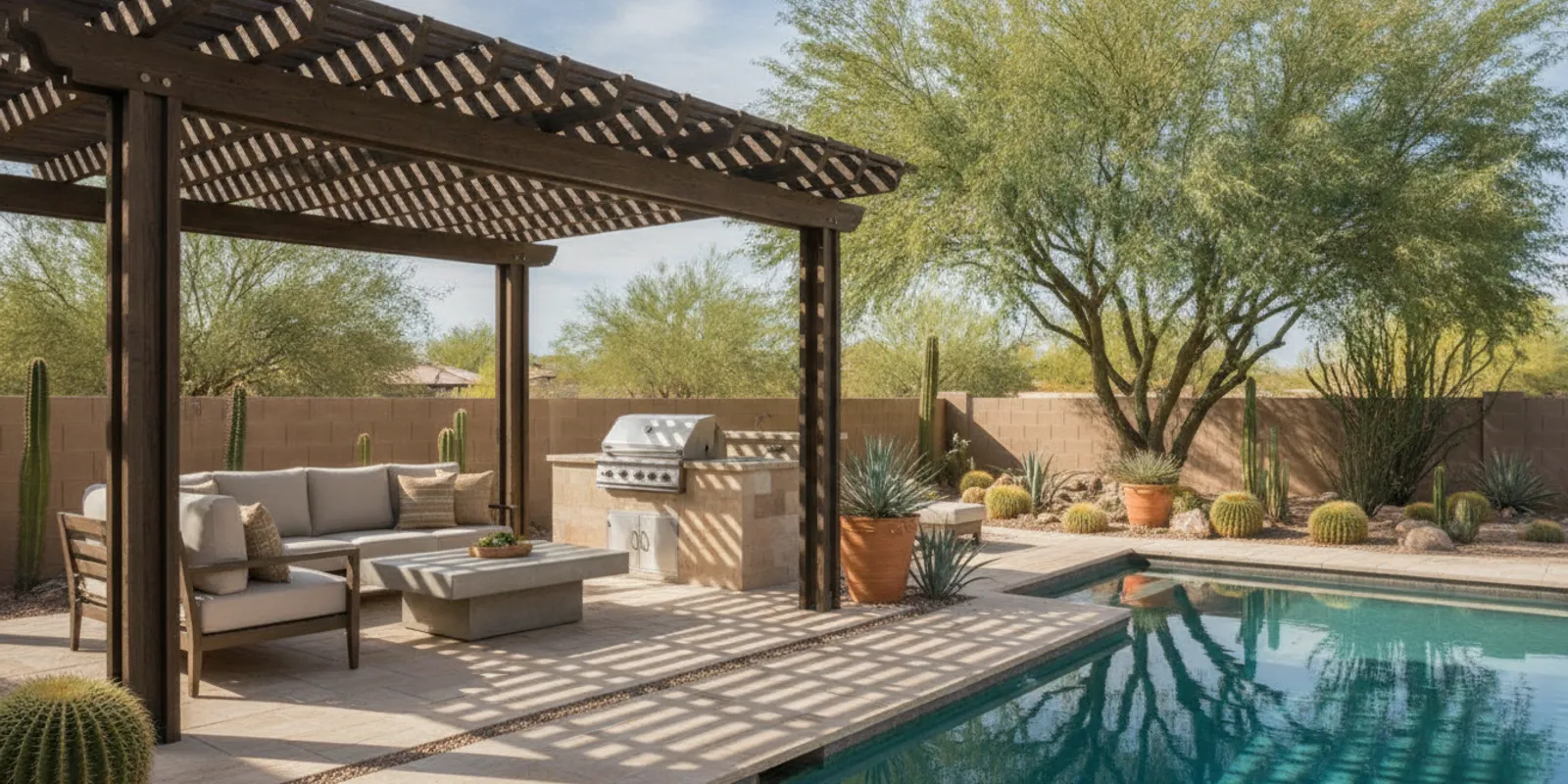
Begin with the way you plan to use the space. A pergola may define an outdoor dining area, provide a visual frame for a seating zone, or connect a pool patio to an outdoor kitchen. The purpose guides decisions about size, placement, shade, and nearby features.
Before comparing companies, write down a few practical details:
- How many people should comfortably sit or dine beneath it?
- Will it sit beside a pool, over a patio, or near an outdoor kitchen?
- At what times of day do you want shade?
- Do you want an open-air structure, or are you considering additional shade elements?
- What paths, doors, windows, utilities, and existing landscape features must remain accessible?
In Arizona, the position of the sun changes the experience of a patio over the day and across the seasons. Ask each company to explain how the proposed placement and design relate to the specific yard. A pergola does not automatically provide complete shade at every hour; the result depends on orientation, dimensions, roof design, and sun exposure.
Turn those answers into a short project brief before the first meeting. For example, you might describe a dining area for six near the patio door, note that afternoon glare is the main concern, and identify a clear route from the house to the pool. A second homeowner may want an open structure that frames a lounge area without blocking a view. These different goals should lead to different layouts, so the brief helps each company respond to the same priorities instead of guessing from a broad request for a pergola.
How do you compare pergola companies fairly?
Compare the same project brief with each company. If one proposal includes site preparation and another only describes a structure, their totals and schedules are not directly comparable. Share a consistent list of goals, site information, and questions, then evaluate the answers as well as the proposed design.
Look for clear responses to these points:
- Relevant scope: Does the company explain what it will design and install, and what is outside the work?
- Site review: Will someone assess access, grade, existing paving, drainage, and nearby structures?
- Written detail: Are dimensions, materials, finish selections, and responsibilities described in the proposal?
- Coordination: If the project includes landscaping, a pool, or an outdoor kitchen, who coordinates those elements?
- Communication: Who is your contact, how will changes be documented, and how will you receive schedule updates?
Ask for examples of comparable work and, if available, visit a completed project or review a project gallery. For examples of integrated backyard work, see the Modern Pools project gallery and its overview of pool and outdoor living services. These pages can help you discuss how a shade structure might relate to the rest of the yard; they are not a substitute for reviewing the exact scope of your own project.
Use a repeatable comparison method after the meetings. First, mark each proposal as complete, unclear, or not included for the same list of requirements. Next, send each company the same follow-up questions about unclear items. Finally, compare the revised written scopes, not a verbal estimate against a detailed document. If you are deciding between two layouts, ask each company to explain the trade-off: for example, whether a larger footprint leaves enough room for circulation, or whether shifting the structure improves shade at the hours you use the patio. Recording the answers in one place makes differences visible without reducing the decision to a single number.
Which design and material details belong in a proposal?
A useful proposal makes it possible to understand what is being planned, even before construction begins. Ask for a drawing or clear description that shows the pergola's location, approximate dimensions, height, orientation, and relationship to the house and patio. Confirm how the design handles transitions to existing surfaces and whether any site preparation is included.
Materials should be identified specifically rather than described only as “low maintenance” or “built to last.” Ask the company to state the proposed material and finish, the care it may require, and how it is intended to perform in the local climate. Do not assume that a material or product is included unless it appears in the written scope. Compare the actual specifications, not a material label alone.
Also clarify what “shade” means in the proposal. An open roof, a slatted design, and an added shade covering can create different experiences. Ask how the proposed configuration addresses your preferred time of use and whether any optional component changes the price or installation plan. A pergola provides a defined outdoor structure, but it should not be described as blocking all sun or replacing other cooling measures.
Look at a proposed layout from the everyday viewpoints that matter to you. Check whether the structure could interrupt a door swing, narrow a walkway, or compete visually with the house. If outdoor dining is the goal, consider chair movement and the path for carrying food between the kitchen and table, not just whether the table fits on paper. Around a pool, ask how people will move between the water, seating, and shaded area. Request that important clearances and connections appear in the drawing or written description so that you can react to the actual plan.
For materials and finish, ask how the selection relates to nearby surfaces and the home's exterior, as well as what routine cleaning or upkeep is expected. If a proposal offers alternatives, request a side-by-side description of what changes: appearance, maintenance, shade configuration, included components, or installation requirements. That gives you a practical basis for weighing the options without relying on a broad label or an unverified performance promise.
For work in Phoenix, the City of Phoenix website is a starting point for locating current planning and development information. Homeowners elsewhere in the East Valley should check with the authority for their own property. Include materials, dimensions, structural specifications, and local building regulations in your questions. Confirm project-specific requirements with the relevant local authority and your contractor.
What should the installation scope spell out?
“Pergola installation” can refer to different amounts of work. One company may supply and assemble the structure, while another may also handle site preparation, footings, connections to existing hardscape, or coordination with adjacent improvements. Get a written description of what each party is responsible for before comparing proposals.
Ask whether the proposal addresses:
- Site measurement and final design approval.
- Removal, excavation, surface preparation, or disposal, if needed.
- Structural supports and how the structure will be secured, as applicable to the design and site.
- Delivery, installation, cleanup, and protection of nearby areas.
- Electrical work, lighting, or other additions, if they are part of your plan.
- Landscape, patio, pool, or kitchen work that is included, excluded, or handled by another contractor.
Do not treat an item as included because it appears in a picture or was discussed informally. Ask for it to be listed in the written scope, along with any stated allowance or condition. If the pergola is part of a larger backyard transformation, discuss how the separate elements will be sequenced. Modern Pools describes its broader hardscape and landscape work and outdoor kitchen projects; these may be useful starting points when considering how a shaded area connects with the rest of the outdoor space.
Think through a simple handoff example. If paving must be adjusted before supports can be installed, ask who schedules that work and who confirms the surface is ready. If lighting or another addition is planned, ask whether the proposal includes the related work or whether a separate trade must be arranged. If another contractor is involved, request clarity about access, timing, and responsibility for protecting finished surfaces. These details are easy to overlook when a concept image shows a completed backyard but does not explain the sequence that gets it there.
Who checks permits and local requirements?
Permit and review requirements can depend on the location, design, property conditions, and scope of work. Do not rely on a general statement that “pergolas never need permits” or “everything is included.” Ask the company to explain which requirements it has considered and who will verify them for your specific property.
Before you proceed, clarify in writing:
- Who will check applicable city or county requirements?
- Who will prepare and submit any required applications or plans?
- Are permit costs, plan changes, and approval timelines addressed in the proposal?
- Does your homeowners association require a separate review or approval?
- Are there property-line, easement, drainage, or access questions that need to be checked?
Homeowners should verify requirements with the relevant authority rather than assume one city's process applies across the Phoenix East Valley. Make sure the proposal explains what the company will handle and what information or approvals you must provide.
Make this conversation specific to the property. Provide the address and any available site plan or HOA guidelines, then ask which details still need verification. If a structure is near a property line, an easement, or an existing pool or utility area, call that out early rather than waiting until installation planning. Ask the company to distinguish between its own coordination tasks and approvals that remain the homeowner's responsibility. Keep the response with your proposal so that permit and review assumptions are not lost when the project moves from design discussion to scheduling.
How can you compare scope, price, and communication?
Price comparisons are useful only when the scope is clear. Ask each company for a written proposal with the same basic information: structure dimensions, material and finish, site preparation, installation, permit responsibilities, exclusions, and any selected options. Modern Pools emphasizes transparent, published pricing on its pool packages, but pergola costs and project scope should be confirmed for the specific design rather than inferred from pool package prices.
| Comparison point | What to look for | Question to ask |
|---|---|---|
| Design | Dimensions, placement, orientation, and a clear description or drawing | How does this layout provide the shade and use area I described? |
| Materials | Named material, finish, and care expectations | What exact material and finish are included? |
| Installation | Site preparation, installation, cleanup, and exclusions | Which tasks are included, and which are assigned to me or another contractor? |
| Permits and reviews | Named responsibility for checking and handling applicable requirements | Who verifies local and HOA requirements and manages any applications? |
| Price and changes | Written scope, listed options, and a process for documenting changes | How are additions or design changes described and approved? |
| Communication | A contact person, update method, and clear next steps | Who will update me, and how will schedule changes be communicated? |
Ask what could change the proposed price or schedule, and how any adjustment would be discussed and documented before work proceeds. This is not an invitation to anticipate hidden charges; it is a way to make sure both sides have the same understanding of scope, selections, and responsibilities. If an answer is vague, request a written clarification before comparing the proposal with another.
When you review totals, separate the base scope from optional selections and any clearly stated allowances or conditions. For instance, compare the same dimensions and finish first, then note whether one proposal includes a shade component or site preparation that another leaves out. Do not treat a lower total as like-for-like until those differences are explained. Likewise, a more detailed proposal is not automatically the better fit; it is useful because it lets you see what the price covers and identify choices that need a decision.
What should you expect from project communication?
Good communication starts before installation. Ask how the company will confirm measurements and selections, what must be decided before work begins, and how it handles a design change or an unexpected site condition. You should know whom to contact and how decisions will be recorded.
Request a simple sequence of anticipated steps, such as design confirmation, site review, any required approvals, ordering, installation, and final walkthrough. The exact order and duration depend on the project and approvals, so be cautious of a promise that ignores site-specific factors. Ask when you will receive updates and what would trigger a schedule adjustment.
When evaluating a company, consider whether its answers are specific to your yard. A clear explanation of what is known, what still needs checking, and who will follow up is more useful than a broad assurance. Modern Pools describes an owner-involved approach; ask any prospective company how oversight and communication will work on your project.
Before signing, agree on a simple way to record decisions. A written message or updated proposal can confirm a change to dimensions, finish, options, or timing. Ask who should approve a change and whether work pauses until the revised scope is clear. For the final walkthrough, ask what the company will review with you, such as the completed installation, agreed selections, and any care information it provides. The goal is not to create unnecessary paperwork; it is to keep the homeowner and project team working from the same current plan.
What are useful questions to ask before you hire?
Bring a short checklist to each consultation so you can compare the responses afterward. Consider asking:
- What information do you need to prepare a design and written proposal for my yard?
- Can you show how the layout responds to the sun, access, existing patio, and intended use?
- Which material, finish, and roof configuration are included, and what options are available?
- What installation tasks are excluded or assigned to another contractor?
- Who checks permit and HOA requirements, and who manages any required submissions?
- How do you document changes to selections, scope, cost, or timing?
- Who will be my contact from design through the final walkthrough?
- What should I prepare before the next step?
Take notes and compare the answers against the written proposal. If a detail matters to your decision, ask for it to be documented rather than relying on a verbal summary.
After the meetings, write down any open questions and send them together instead of making decisions from scattered conversations. You can also ask each company to identify what information it still needs from you, such as preferred location, HOA guidance, or access details. A clear response helps you see whether the process is organized and whether the proposal is ready for a fair comparison. If an important answer changes, ask for the written scope to reflect it before you choose.
Frequently Asked Questions
Does every pergola company handle permits?
Responsibilities vary by company and project. Ask who will verify applicable local requirements, prepare any needed documents, submit applications, and communicate approval timing. Confirm the answer in the written proposal.
Should I choose a pergola company that also works on the rest of the backyard?
That depends on whether your project includes connected work such as landscaping, a pool, or an outdoor kitchen. A single company may help coordinate related elements, while separate specialists can have distinct scopes. In either case, clarify who manages sequencing, access, and handoffs.
How can I tell whether two proposals are comparable?
Line up the design dimensions, named materials and finishes, site preparation, installation tasks, permit responsibilities, exclusions, and options. Ask each company to clarify differences before comparing totals.
What should I do before asking for a pergola estimate?
Note how you plan to use the space, preferred location, times when you want shade, approximate seating needs, and any existing conditions or features that must remain. Photos and a rough sketch can help start a conversation, but the company should verify measurements on site.
Choose with the written scope in view
The right pergola company should be able to explain the design, installation scope, local requirement checks, and communication plan in a way you can compare. Take time to review the written proposal and confirm that it reflects how you want to use your Phoenix-area backyard before moving forward.