

Building a pool in the Phoenix area is a major investment, and the most expensive problems often begin before excavation. A low bid, unclear scope, overlooked soil condition, or rushed permit decision can create change orders and delays that are far harder to fix once construction begins.
The most common pool building mistakes arizona homeowners make are choosing a builder by price alone, accepting an incomplete contract, underestimating permits and HOA approvals. Ignoring soil conditions, skipping efficient equipment, overlooking the surrounding landscape, and failing to confirm who will oversee the work. A qualified, hands-on builder can identify these risks early and explain the costs clearly.
Before comparing designs or finishes, it helps to understand where Phoenix-area projects typically lose money. This custom pool construction guide provides useful context, while the sections below show how careful planning and transparent communication protect your backyard transformation.
Book an Estimate to discuss your pool project with an owner-involved builder
The Most Expensive Pool Building Mistakes Arizona Homeowners Make
A backyard pool should create years of enjoyment, not a chain of expensive corrections. In Arizona, the largest overruns often begin before excavation, when homeowners compare bids without comparing scope, overlook site conditions, or assume someone else is managing the details. Understanding these pool building mistakes arizona homeowners commonly face makes it easier to protect both the project and the investment.
Review the fundamentals of custom pool construction before selecting a design or contractor. Then watch for these seven cost-driving mistakes:
- Choosing by price alone: The lowest bid may leave out finishes, equipment, preparation, or cleanup. A lower starting number can become more expensive when missing scope turns into additions. This low-bid trap is a recognized Arizona construction risk, not simply a matter of personal preference.
- Accepting a vague contract: If the agreement does not itemize materials, equipment, allowances, schedule responsibilities, and exclusions, it is difficult to compare proposals or challenge an unexpected charge.
- Ignoring the permit and HOA timeline: Delays can affect excavation, inspections, construction sequencing, and other trades. The contract should clearly identify who handles permits, HOA approvals, notifications, and cleanup.
- Overlooking Arizona soil conditions: Expansive clay and other site conditions can create structural problems when they are not investigated and addressed during planning.
- Skipping automation and energy planning: Retrofitting controls, efficient pumps, or lighting after construction can cost more and produce a less integrated result than planning them with the pool.
- Forgetting the landscape and hardscape budget: The pool is only one part of a backyard transformation. Decking, drainage, planting, shade, kitchens, and fire or water features can materially change the total investment.
- Assuming oversight happens automatically: Without a clearly accountable person monitoring workmanship, decisions, schedule, and budget, small issues can compound before anyone addresses them.
| Mistake | Why it costs money | How to avoid it |
|---|---|---|
| Choosing by price alone | Missing scope turns into change orders | Compare itemized scopes, not headline bids |
| Going in without a fixed contract | Unclear charges and disputes | Require a written, itemized, signed agreement |
| Underestimating permit and HOA timelines | Delays and rework | Assign permit, HOA, and cleanup responsibility in writing |
| Ignoring soil and site conditions | Structural damage to the shell | Assess expansive clay and site prep before building |
| Skipping automation and efficiency | Costly retrofits later | Plan pumps, lighting, and controls up front |
| Forgetting landscape and hardscape | Second-round design and rework costs | Budget the whole backyard, not just the pool |
| Missing active oversight | Small issues compound unnoticed | Confirm who monitors the build day to day |
Start with verification, not promises. The Arizona Registrar of Contractors advises homeowners to confirm a contractor’s license before signing. Check the license directly through the ROC before-hire guidance, and make sure the company and scope in the contract match the business you are evaluating. That simple step helps establish a stronger foundation for every decision that follows.
Choosing a Builder by Price Alone
A low initial price can look appealing, especially when pool proposals seem difficult to compare. But the lowest bid is not always the strongest value. A proposal may leave out important work, use different allowances, or provide less detail about equipment, site preparation, cleanup, and finish materials. When those omissions surface later, the homeowner may face added costs, schedule pressure, or quality compromises. The low-bid trap is a documented pool-construction mistake associated with hidden costs and poor workmanship, not a reliable way to protect your investment.
Instead of asking only, “Who is cheapest?” compare what each builder is committing to deliver:
- Scope: Confirm the pool, decking, equipment, features, site preparation, inspections, and cleanup included in the proposal.
- Specifications: Compare equipment brands, energy features, finish selections, structural details, and allowances rather than comparing one total number.
- Payment structure: Make sure payments correspond to completed work and that changes are documented before the work proceeds.
- Credentials: Verify the contractor’s Arizona Registrar of Contractors license and ask whether the required bond is in place.
Arizona’s ROC explains that a contractor must possess a bond to become licensed. You can also confirm a contractor’s license before signing through the Arizona Registrar of Contractors. These checks do not replace careful proposal review, but they create a more dependable starting point.
Modern Pools takes a value-led approach with transparent published package pricing and clearly defined inclusions. That gives East Valley homeowners a practical baseline for evaluating what they receive, while custom projects can account for site conditions, design choices, permits, and taxes. The goal is not the lowest headline number. It is a well-defined investment with no surprise charges and hands-on oversight from a qualified team.
For a more complete checklist, use this guide to selecting a qualified pool builder before comparing final proposals.
Going In Without a Fixed, Itemized Contract
A pool proposal should make it easy to see what you are paying for, what is included, and what could change. A single bottom-line number without specifications leaves too much room for confusion, especially when excavation, access, equipment, decking, permits, and cleanup are discussed separately.
Before signing, ask for an itemized contract that connects each payment to a defined scope of work. It should identify the pool design, materials, equipment, included features, allowances, payment schedule, estimated milestones, and responsibilities for permits, HOA approvals, and debris removal. This is the foundation of transparent pricing and helps you compare proposals based on the same work, not just the headline price. For more context, review this guide to understanding true pool building costs.
Require written approval for every change
Arizona homeowners should treat changes as formal contract decisions, not casual conversations in the backyard. If the design, materials, equipment, or scope changes, require a written change order that explains the added or reduced cost and any schedule impact. The Arizona Registrar of Contractors states that a change order must be signed by both the contractor and the homeowner to be valid. You can review its consumer guidance at the Arizona Registrar of Contractors.
This protects both sides. It gives you a chance to understand why a change is needed before approving it, while giving the builder a clear record of the work you authorized. A transparent builder should never rely on vague promises that an upgrade, site condition, or substitution will be sorted out later.
Keep payments traceable and tied to progress
- Never pay in cash. The ROC recommends making checks payable to the company or contractor name listed in your signed contract.
- Match each payment to completed work or a clearly defined contractual milestone.
- Do not allow payments to get ahead of the work completed on site.
- Keep copies of the signed contract, change orders, invoices, receipts, and payment records.
These habits do not make the process adversarial. They create a shared record and reduce the risk of surprise charges. Modern Pools approaches pool construction with published package pricing and no-hidden-charge expectations, so homeowners can make an informed decision before construction begins. The right contract should leave you confident about the investment, not wondering which important detail was left out.
Get an itemized estimate that makes the scope clear before you sign
Underestimating the Permit and HOA Timeline
A pool project can be fully designed and still sit idle if the approval path is treated as an afterthought. Phoenix East Valley homeowners may need to coordinate city or county permits, inspections, HOA review, and neighborhood restrictions before excavation begins. Each organization has its own forms, review times, corrections, and meeting schedules.
Do not assume that saying “the builder handles permits” makes the responsibility clear. Arizona’s Registrar of Contractors explains that permits are the property owner’s responsibility, although many contractors include permit costs and obtaining services in the contract. The same guidance notes that homeowners are responsible for notifying the contractor about applicable HOA covenants, conditions, and restrictions. Put those details in writing before signing.
Clarify every approval responsibility in the contract
Your agreement should identify who prepares and submits permit applications, pays fees, responds to plan-review comments, schedules inspections, and supplies corrections if an application is rejected. It should also state who submits HOA materials, tracks approval, and handles required site cleanup and debris removal. These items are not minor administrative details. Unclear ownership can create delays, change-order disputes, or a finished backyard that does not meet neighborhood requirements.
Ask for a realistic timeline that separates design, HOA review, permit issuance, construction, and inspections. A local builder familiar with Scottsdale, Chandler, Mesa. And Tempe can anticipate common documentation requirements and coordinate the sequence more effectively than a contractor unfamiliar with East Valley jurisdictions. That local knowledge helps, but it does not eliminate the need for homeowner communication and timely decisions.
Plan for Arizona’s pool-enclosure requirements
Approval planning must include safety requirements, not just excavation and plumbing. Arizona law requires a swimming pool or other contained body of water that is eighteen inches or more deep at any point to have an enclosure surrounding the pool area. The statute is available from the Arizona Legislature. Depending on the property and design, the enclosure may affect fence placement, gates, access routes, landscaping, and HOA drawings.
Before construction starts, confirm how the proposed pool, barriers, equipment, drainage, and outdoor living features fit together. Review the approval schedule with the builder, and reserve time for corrections rather than planning around the most optimistic date. For more guidance on avoiding pool permitting issues, use a written checklist and keep copies of every submission and approval.
Ignoring Arizona’s Soil and Site Conditions
Arizona’s desert setting affects more than the plants around a new pool. Soil movement, drainage, grading, access, and the relationship between the pool shell and surrounding hardscape all influence how the project should be designed and built. Treating every backyard like a level, uniform construction site can create expensive problems after the crew has left.
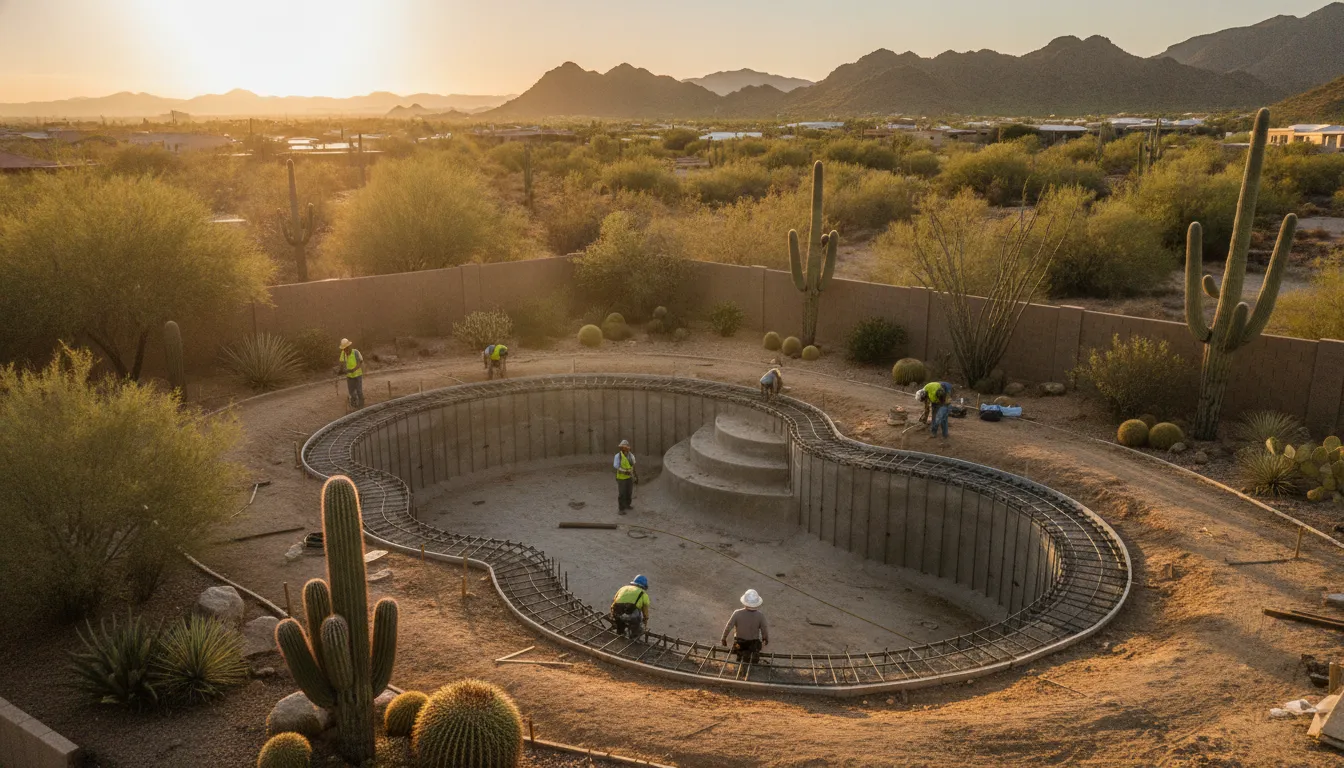
Expansive clay is one risk homeowners should discuss before excavation. When this soil absorbs and releases moisture, it can move. That movement may place stress on a pool shell and contribute to structural failures if the site is not properly evaluated and addressed. The risk is recognized in Arizona pool-construction guidance, which lists ignoring expansive clay and other unique soil conditions as a serious mistake: Arizona soil conditions can affect pool construction.
What should a site evaluation cover?
A qualified builder should assess the lot before finalizing the design and price. Depending on the property, that may include reviewing available geotechnical information, identifying expansive or unstable soil. Checking drainage patterns, confirming finished elevations, and planning for groundwater or difficult access. A geotechnical report may also be appropriate when soil conditions are uncertain or the site has a history of movement.
- Soil: Determine whether excavation and structural plans need to account for expansive clay, fill, rock, or other challenging conditions.
- Drainage: Plan where rainwater and landscape runoff will go so water does not collect against the pool or nearby structures.
- Elevation: Coordinate the pool, deck, yard, and existing home so the finished space drains correctly and feels intentional.
- Materials: Select concrete, coping, tile, decking, drainage components, and landscape materials that can perform in Arizona’s heat and seasonal weather.
Site conditions should be reflected in the plans and the contract, not treated as an afterthought or an unexplained change order. Ask what testing is recommended, which conditions are included in the scope, and how unexpected excavation will be handled. Clear answers make the budget more dependable and help prevent rushed decisions once digging begins.
Local experience matters because East Valley lots vary widely. A builder familiar with Scottsdale, Chandler, Mesa, and Tempe can anticipate desert grading, permitting coordination, HOA requirements, and material choices that suit the climate. The goal is not simply to install a pool. It is to build a stable, well-drained backyard transformation that continues to perform long after the water is filled.
Skipping Automation and Energy-Efficiency Upgrades
A pool can look complete on opening day and still be expensive to operate. In Arizona, intense summer heat, long swim seasons, and high demand on home cooling systems make equipment choices especially important. Treating automation and efficiency features as optional extras can leave you with higher utility bills and more hands-on maintenance.
Build these systems into the design from the start:
- Variable-speed pumps: These allow the circulation system to run at lower speeds for routine filtration and increase output when the pool needs more circulation or cleaning. Matching the pump schedule to actual demand can reduce unnecessary energy use.
- Smart automation: A connected control system can coordinate pumps, heaters, sanitization, water features, and lighting from one interface. That makes it easier to follow a consistent schedule instead of leaving equipment running longer than necessary.
- LED lighting: LED fixtures use less energy than older pool lighting and give you flexible control over evening ambience. Thoughtful placement also highlights steps, tanning ledges, and water features without over-lighting the entire yard.
- Automation-ready plumbing and electrical planning: Future equipment is easier to support when conduits, access points, and utility requirements are considered during construction rather than forced into a finished deck.
Why planning matters in the Arizona heat
Efficient equipment does not mean choosing the smallest system or removing features you want. It means sizing the circulation, filtration, heating, and control systems around the pool’s volume, usage, sun exposure, and outdoor-living plan. A qualified builder can also account for the way desert dust, heat, and frequent evaporation affect maintenance routines.
Retrofitting controls, wiring, fixtures, or equipment after the deck and landscape are finished may require demolition, new access work, and changes to existing connections. Installing the right infrastructure during the build is usually far less disruptive and often more economical than rebuilding around it later. It also protects the lifestyle value of the pool: scheduled circulation and lighting can keep the backyard ready without making daily operation another chore.
Ask for an itemized explanation of each efficiency and automation upgrade, including what it controls, how it is sized, and what maintenance it requires. Transparent planning helps you compare meaningful long-term value instead of judging the proposal only by its starting price.
Not Asking Who Oversees Your Build or Budgeting for the Landscape
A pool project involves more than a design, a crew, and a completion date. Ask who will actually oversee the work after the contract is signed. Will a consistent, accountable team coordinate excavation, plumbing, electrical work, inspections, finishes, and the decisions that arise on site? Or will communication pass between disconnected crews with no clear point of responsibility?
Modern Pools takes an owner-involved, hands-on approach to oversight. That means leadership stays close to the project, workmanship is monitored, and homeowners have a clear team to contact throughout the build. The goal is not simply to place a pool in the yard. It is to deliver a coordinated backyard transformation that reflects the approved design and the expectations set during the estimate.
What to ask before signing with a pool builder
- Who is my primary contact once construction begins?
- Who checks the work between major phases?
- How are design questions, site discoveries, and schedule changes documented?
- Which parts of the project are handled by the builder, and which are assigned to separate contractors?
Clear answers can reveal whether a builder is prepared to manage the full experience or is focused mainly on getting the contract signed. They also help you compare proposals based on accountability and coordination, not just the starting number.
Plan the whole backyard, not only the pool
Another costly oversight is budgeting for the pool while leaving the surrounding property as an afterthought. In Arizona, the finished project may also require hardscape, landscape, drainage considerations, shade, and spaces that make the yard comfortable and usable. If those elements are postponed, homeowners may face a second round of design decisions, demolition, or mismatched finishes.
Build a complete wish list early. Depending on how you use the space, that may include:
- Patios, decking, walkways, and other hardscape
- Desert-appropriate landscape and planting areas
- An outdoor kitchen or dining zone
- Fire features for evening use
- Water features that complement the pool design
Planning these components together helps the pool, materials, elevations, lighting, and entertaining areas work as one design. It also creates a more realistic view of the total backyard transformation budget. A detailed estimate should make the scope clear, including what is included, what is custom-priced, and which items may require separate decisions.
When evaluating the final candidates, choose a builder who can discuss both construction oversight and the complete outdoor living vision. That conversation is a practical way to reduce surprises and move from a rough pool idea toward a confident plan.
Book a consultation to talk through oversight, scope, and your full backyard plan
Frequently Asked Questions
What are the most common pool building mistakes to avoid in Arizona?
The costliest mistakes usually involve choosing a builder by price alone, skipping soil and site planning. Accepting an unclear contract, and failing to define responsibility for permits, HOA approvals, or cleanup. Homeowners should also verify the contractor’s ROC license and bond before signing. The Arizona Registrar of Contractors recommends checking a contractor before hiring.
How do Arizona’s soil conditions affect pool construction?
Arizona soil can include expansive clay, which may move as moisture conditions change. If site conditions are not evaluated and addressed during design and construction, movement can contribute to structural problems in a pool shell. Ask the builder how the site will be assessed, what preparation is planned, and which soil-related work is included in the contract.
Why is choosing the cheapest pool builder a risky mistake?
The lowest initial bid may leave out important work, allowances, or site-related costs. That can create change orders, delays, or compromises in materials and workmanship. Compare itemized scopes instead of headline prices, confirm the contractor’s license and bond, and ask what is specifically included before deciding.
What should I look for when choosing a pool builder in Arizona?
Look for a current ROC license, a required contractor bond, an itemized written contract, clear payment milestones, and a defined process for changes. Arizona guidance says never pay in cash, do not let payments get ahead of completed work, and require change orders to be signed by both parties. Those details make the project easier to manage and reduce avoidable disputes.
Ready to Book an Estimate?
A thoughtful planning conversation can help you align the design, site considerations, and budget before construction begins. Modern Pools brings owner-involved oversight and transparent guidance to Phoenix East Valley pool projects.