
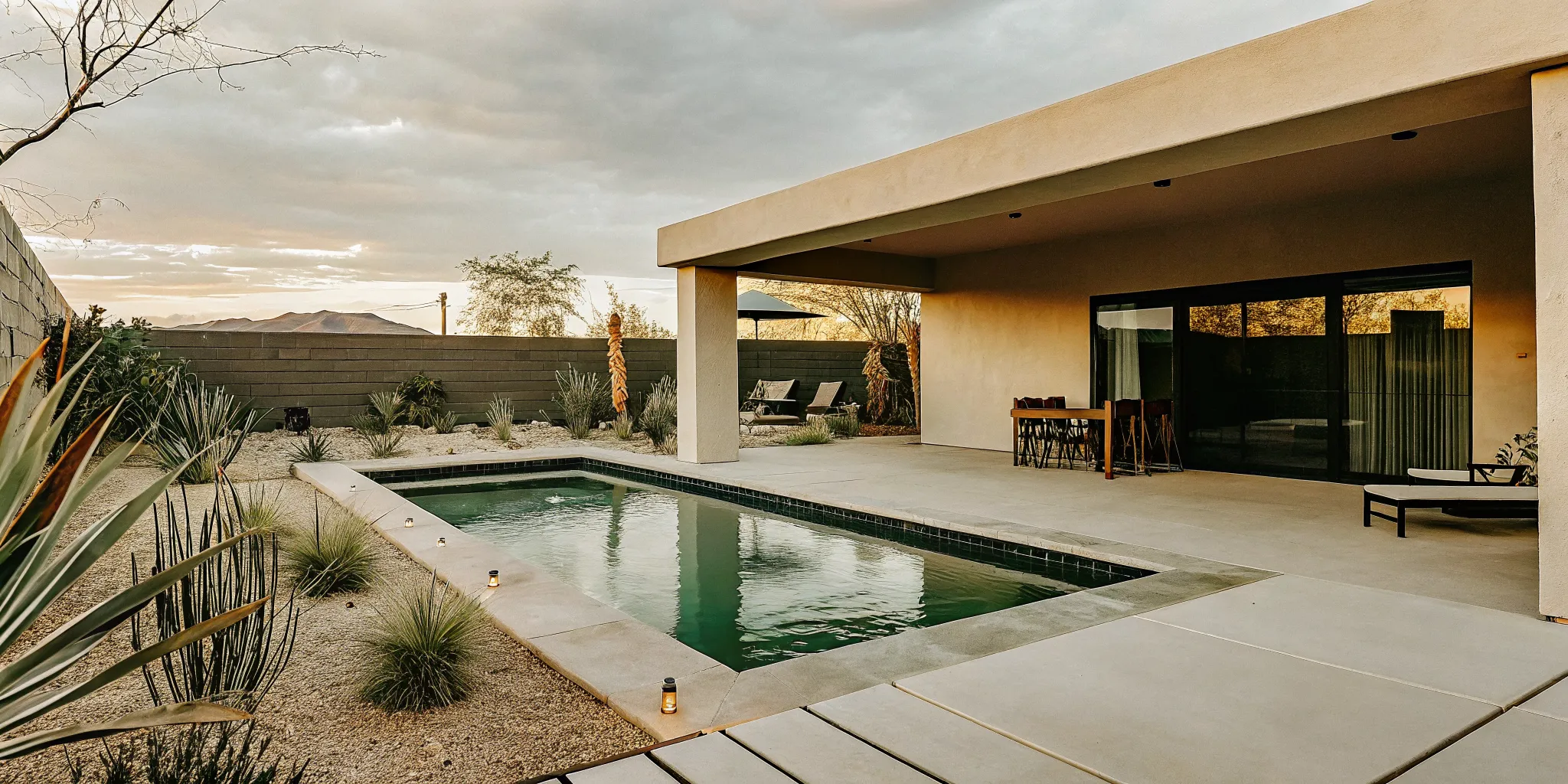
In Arizona, a pool has to do more than look beautiful in a rendering. It needs to support daily outdoor living, suit intense sun and heat, and work naturally with the rest of your yard. That makes early decisions about design, materials, equipment, and permitting especially important for homeowners in Scottsdale, Chandler, Mesa, and Tempe.
Book your free estimate today and start planning your custom pool construction arizona project with transparent pricing and owner-involved oversight from day one.
Custom pool construction arizona projects are best approached as complete lifestyle investments: define how you will use the backyard. Choose desert-appropriate materials and efficient equipment. Work with a builder who provides transparent pricing and owner-involved oversight from design through completion.
Modern Pools brings that approach to the Phoenix East Valley, with German Samaniego and Vincent Russo personally overseeing every project. The company also combines pool construction with outdoor living features under one contract, helping the finished space feel intentional rather than pieced together. Here is what the process involves, from the first consultation through the final details.
How Does Custom Pool Construction Work in Arizona?
Custom pool construction in Arizona follows a defined sequence: consultation and 3D design, engineering and permitting. Excavation and steel reinforcement, gunite shell application, plumbing and electrical rough-in, coping and tile, decking and landscaping, and final walkthrough. Each stage prepares the site for the next, with local permitting and drainage requirements shaping the timeline.
A successful backyard transformation follows a defined sequence, with each stage preparing the site for the next. In the Phoenix East Valley, that sequence must account for local permitting, drainage. Desert conditions, and the way the pool connects to the rest of the outdoor living space. Modern Pools manages the work under one contract, with German Samaniego and Vincent Russo providing owner-involved oversight throughout the project.
- Consultation and 3D design: The process begins with a conversation about how you want to use the backyard, followed by site evaluation, layout planning, and a 3D rendering. This gives you a clearer view of the pool, spa, hardscape, and potential features before excavation begins. It also helps the team coordinate integrated outdoor living elements instead of treating the pool as an isolated project. View Modern Pools’ new pool build services to see how the planning stage fits into a complete build.
- Engineering, permitting, and preparation: Once the design is approved, engineering details, setbacks, drainage, safety barriers, and applicable HOA requirements are addressed. Proper drainage planning helps prevent standing water around the deck and protects nearby landscaping. The goal is to resolve site and approval requirements before construction crews begin, reducing avoidable changes later.
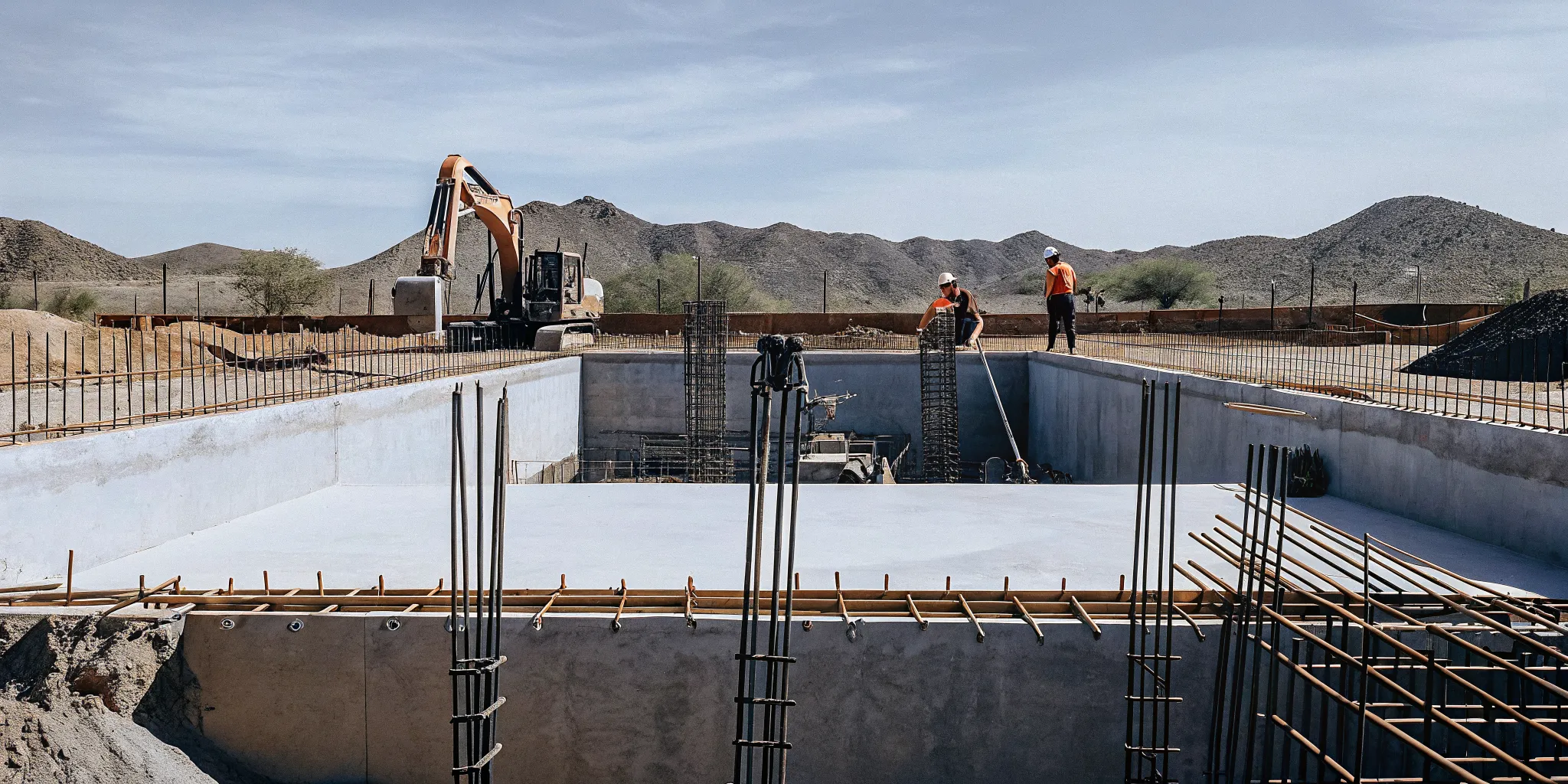
- Excavation and steel reinforcement: Crews mark the approved layout, excavate the pool, and place the steel rebar that reinforces the shell. This is where the design becomes a physical structure, so accurate dimensions and careful preparation matter. The excavation also establishes space for steps, benches, spas, equipment runs, and connected features.
- Gunite or concrete shell application: Gunite or concrete is applied over the reinforced structure to form the pool shell. The quality and thickness of this application are central to long-term structural integrity. After the shell cures, the project can move forward with the systems and finishes that make the pool functional and visually complete.
- Plumbing, electrical, and equipment rough-in: Plumbing lines are routed for circulation, filtration, drains, water features, and any attached spa. Electrical work supports pumps, lighting, automation, and other equipment. Water volume calculations guide pump and filter sizing so the system can support proper circulation and sanitation rather than relying on a one-size-fits-all setup.
- Coping and tile installation: Coping defines the pool edge, while tile adds a finished transition at the waterline and around architectural details. These materials should complement the home’s design and perform well in Arizona’s intense sun and seasonal weather. Careful installation at this stage creates a clean connection between the shell, deck, and surrounding yard.
- Decking, hardscaping, landscaping, and water features: The final construction stages connect the pool to the usable backyard. Decking, seating areas, outdoor kitchens, pergolas, fire features, and landscaping are coordinated as one environment. Desert-appropriate plants and materials can create a cohesive look with more manageable maintenance. Modern Pools’ full outdoor living services cover these complementary elements under the same owner-involved approach.
At completion, the team checks finishes, equipment, circulation, and controls before the backyard is turned over. That end-to-end coordination is the practical advantage of working with one accountable builder for the pool and the surrounding outdoor living solution.
How Much Does Custom Pool Construction Cost in Arizona?
Custom pool construction in Arizona ranges from $37,999 for a Basic Pool Package to $51,999 for an Oasis Pool and Landscape Package, plus permits and taxes. Premium Serenity and Resort packages are custom-priced. Modern Pools publishes transparent package pricing so homeowners know what is included before committing.
The right price depends on more than the pool shell. In Arizona, your investment may also include circulation equipment, lighting, automation, decking, landscape work, permits, and the design decisions that make the backyard comfortable through long, hot summers. Modern Pools makes that investment easier to evaluate by publishing package pricing instead of asking homeowners to make decisions from an incomplete allowance sheet.
The Basic Pool Package starts at $37,999, and the Oasis Pool and Landscape Package starts at $51,999. Both prices are plus applicable permits and taxes. The Serenity and Resort packages are custom-priced because their designs, finishes, and outdoor-living elements vary more significantly from one property to another. You can review the package options before scheduling an estimate and see which direction fits your goals.
| Feature | Basic Pool Package | Oasis Pool and Landscape Package |
|---|---|---|
| Starting price | $37,999 | $51,999 |
| Pool shell and equipment | Included | Included |
| Automation, LED lighting, variable-speed pump | Included | Included |
| Hardscaping and landscape design | Not included | Included |
| Permits and taxes | Not included | Not included |
What is included in the package pricing?
A package is more useful when it represents a finished level of performance, not just a starting excavation price. Modern Pools includes automation, LED lighting, and variable-speed pumps as standard features in its base packages. These details affect how the pool operates and feels every day.
Why transparency matters when comparing builders
Many pool companies do not publish meaningful starting prices. Modern Pools treats pricing transparency as a core part of the customer experience. The goal is to provide strong value by including premium fundamentals and explaining what your investment covers.
A custom pool is also a lifestyle investment. For homeowners in Scottsdale, Chandler, Mesa, and Tempe, the right budget should account for an Arizona-ready backyard transformation. An owner-involved team can refine the scope around your property and priorities. Read our detailed Arizona pool cost guide for a deeper breakdown of pricing.
What Permits Are Required for Pool Construction in Arizona?
Residential pool projects in Arizona require city permits addressing setbacks, drainage, safety barriers, electrical work, and plumbing. HOAs may also require separate design approval. Your builder should coordinate both processes, prepare the complete plan package, and schedule required inspections so permitting does not delay construction.
Permitting is a critical early step in any Arizona pool project. The exact requirements depend on the city, property conditions, pool design, and whether your neighborhood has private design rules. For homeowners planning a custom pool in Scottsdale, Chandler, Mesa, Tempe, or Phoenix, the goal is not simply to obtain a permit. It is to submit a complete plan that addresses structural work, drainage, setbacks, electrical and plumbing connections, and required safety barriers.
State standards and local city permits
Arizona regulations provide important technical guidance for public and semipublic pools. For example, the Arizona Administrative Code requires structurally rigid, waterproof, nontoxic construction materials. And it calls for slip-resistant surfaces that do not cause injury or discomfort during normal use. The rules also require construction to follow plans approved by the appropriate department. These provisions are published through Arizona Administrative Code R18-5-207 and R18-5-204. Residential projects may be governed primarily by local building codes, but these standards illustrate why material selection, plan accuracy, and safe detailing matter.
Each municipality has its own application process and review requirements. In Phoenix, pool permits typically address setbacks, drainage, and safety barriers. Mesa, Chandler, Scottsdale, and Tempe may apply their own submittal requirements, inspections, and site-specific rules. Your plans may also need to show equipment locations, access, grading, and utility details before work begins. See our Arizona pool permit guide for city-by-city requirements across the East Valley.
HOA approval and safety barriers
If your property belongs to an HOA, plan for a separate design review. An HOA may regulate visibility from neighboring lots, fencing, finishes, equipment screening, setbacks, and the overall relationship between the pool and the home. HOA approval does not replace a city permit, so both processes should be coordinated before excavation.
Local ordinances also require a compliant safety fence or barrier system around residential pools to help protect young children from accidental drowning. Barrier specifications can affect gates, door access, fence height, and placement, so they should be incorporated into the design rather than treated as an afterthought.
Who handles the permit process?
A qualified builder typically prepares and submits the permit package, coordinates revisions, schedules inspections, and tracks approvals. Modern Pools brings owner-involved oversight and Phoenix East Valley permitting experience to that process. German Samaniego and Vincent Russo personally oversee every project, helping ensure that the design, city requirements, HOA review, and construction plan stay aligned from the beginning.
How to Choose the Right Pool Builder in Arizona
The builder you choose affects design quality, project management, budget accuracy, and long-term satisfaction. Look for proper Arizona ROC licensing, owner-level accountability, published transparent pricing, and a portfolio of local East Valley projects. A builder who personally oversees construction provides more consistent communication and decision-making.
The builder you select affects design quality, project management, and long-term satisfaction. For homeowners comparing options for custom pool construction in Arizona, evaluate the company behind the presentation, not only the rendering.
Verify licensing, insurance, and relevant experience
Confirm the contractor is licensed with the Arizona Registrar of Contractors and carries current insurance. Ask how long the team has been building in Arizona and whether their experience matches your project scope. Local experience matters in the Phoenix East Valley. Scottsdale, Chandler, Mesa, and Tempe each have different permitting expectations, HOA rules, and site conditions.
Look for owner-level accountability
Ask who will oversee your project after the sales meeting. At Modern Pools, founders German Samaniego and Vincent Russo personally oversee every project. Their owner-involved approach provides direct accountability from the first design discussion through construction.
Compare pricing clarity and design quality
Request a written scope that explains what is included, what is custom-priced, and which costs are separate. Transparent package-based pricing makes it easier to compare builders on actual value. Modern Pools also uses 3D design renderings so you can visualize the proposed design before excavation. Use our detailed checklist for choosing the right contractor.
Design Features That Transform Your Arizona Custom Pool
LED lighting, glass tile, automation, variable-speed pumps, infinity edges, outdoor kitchens, pergolas, and fire features can turn a basic pool into a complete backyard living environment. The most effective designs coordinate these elements from the start rather than adding them later. Modern Pools includes premium features like automation and LED lighting in its base packages.
The best backyard designs do more than add water. They create a setting that works for quiet evenings, weekend gatherings, and everyday time outdoors. In Arizona, each feature should also respond to intense sun, warm nights, and the way your family actually uses the space. A thoughtful plan brings the pool, shade, lighting, equipment, and surrounding living areas together instead of treating them as separate additions.
Build atmosphere and comfort into the pool itself
LED pool lighting adds color and ambiance after sunset while improving visibility for nighttime swimming. Glass tile along the waterline provides a decorative, durable finish that catches light and gives the pool a more refined appearance. For properties with a strong view or a dramatic grade change. An infinity edge can make the water appear to flow into the landscape, creating a distinctive focal point.
These choices are most effective when homeowners can see how they work together before excavation begins. Three-dimensional design renderings help visualize the pool, decking, planting areas, and outdoor rooms as one backyard transformation. Browse the Modern Pools project gallery for inspiration as you consider proportions, finishes, and the overall mood you want to create.
Use technology to simplify ownership
Pool automation systems let homeowners manage pumps, heaters, and lighting from a smartphone or tablet. That convenience matters in a climate where equipment may need to run on a consistent schedule, even when you are away. Variable-speed pumps can use less energy than traditional single-speed pumps, while smart energy management can help schedule equipment during off-peak hours. Modern Pools includes automation, LED lighting, and variable-speed pumps in its base packages, so these practical upgrades can be part of the initial design rather than an afterthought.
Extend the backyard beyond the water
An outdoor kitchen turns the pool area into an entertainment hub, allowing meals and conversation to continue without sending everyone back inside. A pergola creates a more comfortable lounge area under the Arizona sun, giving the backyard a useful place to gather between swims. Fire and water features add movement, sound, and a natural evening gathering point. You can explore fire and water feature options to see how flame, spillways, and other details can shape the atmosphere.
Finally, hardscaping should connect these spaces with durable, desert-appropriate materials and thoughtful transitions between the pool, seating areas, and landscape. Native plants and suitable materials can support a cohesive appearance while reducing maintenance demands. When the design is planned as a complete lifestyle investment, custom pool construction in Arizona becomes more than a new pool. It becomes a backyard that feels intentional, comfortable, and ready to use.
What Is the Timeline for Custom Pool Construction in Arizona?
A typical custom pool project in the Phoenix East Valley takes 12 to 20 weeks from contract to swim-ready. The timeline breaks down as: 2-4 weeks for design, 2-4 weeks for HOA and engineering review. 4-8 weeks for city permitting, 8-14 weeks for construction, and 1-2 weeks for final touches. Monsoon season can extend certain phases.
A well-planned custom pool project moves through several distinct stages. In the Phoenix East Valley, a realistic schedule is usually 12 to 20 weeks from contract to swim-ready. Although the design, approval, and construction details of each backyard can change that range. The phases may overlap, but the sequence below gives you a practical view of what happens and where delays commonly occur.
- Initial consultation and design: 2 to 4 weeks. Your builder evaluates the yard, discusses how you want to use the space, and develops the pool layout, features, finishes, and equipment plan. This is where the design needs to account for Arizona sun, drainage, setbacks, and the relationship between the pool, deck, landscaping, and other outdoor living areas. Revisions and 3D views can add time, but they help resolve decisions before excavation begins.
- Engineering and HOA review: 2 to 4 weeks. Structural plans, site details, and engineering documents are prepared for submission. If your neighborhood has an HOA, its design review cycle may run on a fixed meeting schedule. Missing one review window or needing a revision can extend the timeline, so providing accurate property information early matters.
- City permitting: 4 to 8 weeks in the Phoenix metro area. Local permitting typically involves requirements for setbacks, drainage, and safety barriers, with inspections scheduled by the applicable city. Requirements and scheduling vary between Scottsdale, Chandler, Mesa, Tempe, and other municipalities. Your builder should coordinate the submission and respond to plan-review comments rather than treating permitting as an afterthought. See the permitting requirements outlined in Arizona regulations and local guidance: Arizona pool plan requirements.
- Excavation and steel: 1 to 2 weeks. Once approvals are in place, the crew marks the layout, excavates the pool, and installs reinforcing steel. Unexpected soil conditions, access limitations, utility conflicts, or weather can affect this phase.
- Gunite shell application and curing: 2 to 3 weeks. Gunite forms the structural shell, so application quality and curing time are important to long-term durability. The schedule may include inspections and required adjustments before the next trades begin.
- Plumbing and electrical rough-in: 1 to 2 weeks. Crews install circulation plumbing, drains, equipment connections, lighting conduits, and other systems. Equipment sizing should reflect the pool’s water volume so filtration and sanitation work properly.
- Coping, tile, and decking: 2 to 3 weeks. The pool receives its edge treatment, waterline tile, and surrounding deck. Material availability, detailed layouts, and the amount of hardscape can influence the pace.
- Plaster and interior finish: about 1 week. The interior finish is applied after the shell and surrounding work are ready. The pool then begins its start-up process, including filling and balancing the water.
- Landscaping and final touches: 1 to 2 weeks. Final grading, planting, lighting, equipment setup, cleaning, and walkthroughs complete the backyard. Desert-appropriate plants and drainage details help the finished space perform well in Arizona conditions. Read our detailed timeline guide for a phase-by-phase breakdown with scheduling tips.
Monsoon season, generally June through September, can interrupt excavation, concrete work, deliveries, and inspections. The best builders communicate schedule changes clearly and keep the next workable phase organized. A realistic plan leaves room for weather, HOA review cycles, city inspection availability, and small corrections without promising an artificial completion date.
How Does Material Choice Affect Your Arizona Pool?
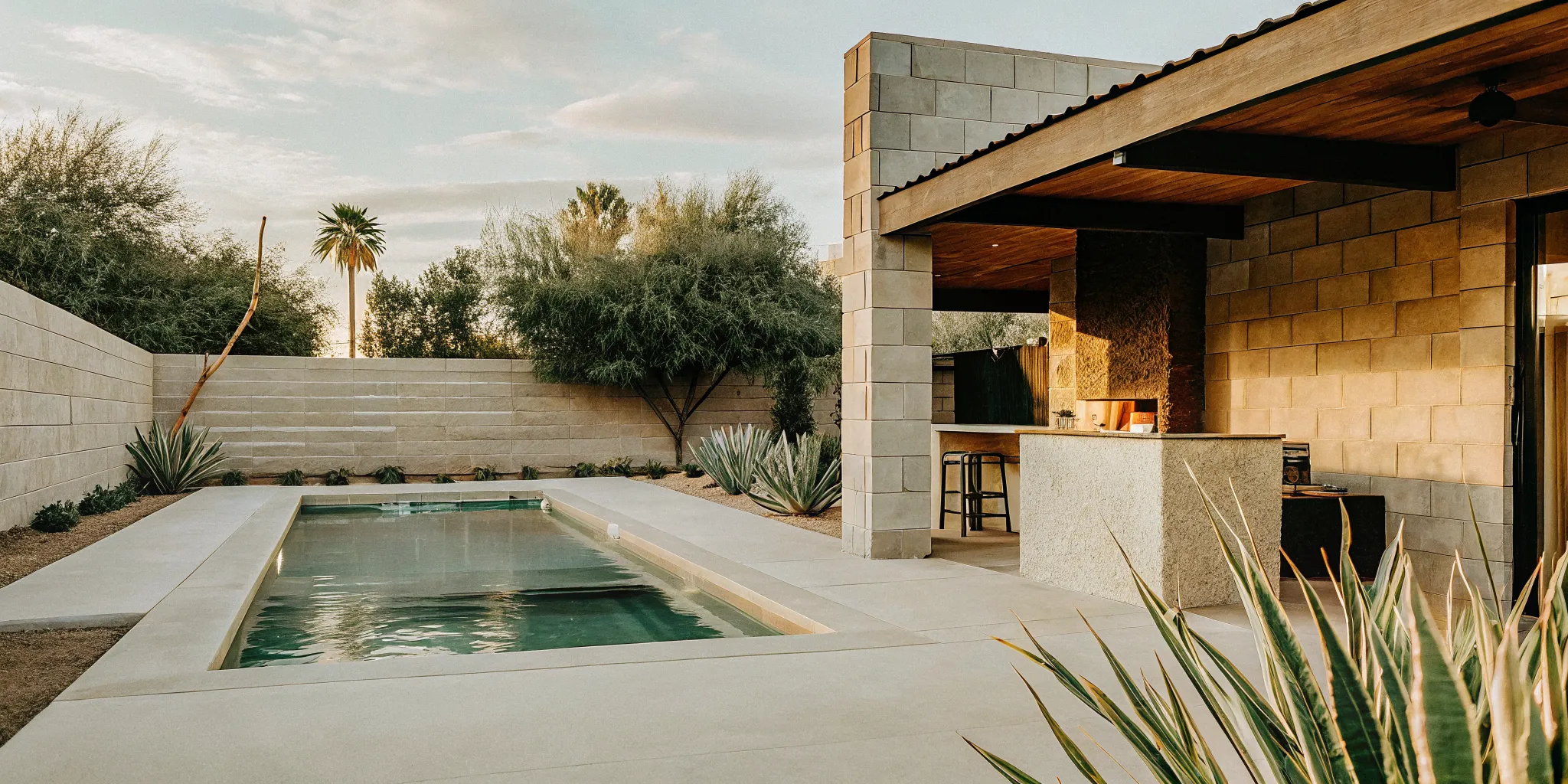
Material choices for pool shells, decking, interior finishes, and equipment affect durability, maintenance, appearance, and long-term cost. Gunite and concrete offer structural flexibility for custom shapes. Cool deck and travertine reduce surface temperatures. Saltwater and chlorine systems each have different maintenance profiles. A qualified builder can match materials to Arizona conditions and your usage priorities.
Material selection is one of the most consequential decisions in custom pool construction in Arizona. The wrong materials can degrade faster in intense sun or require more maintenance. The right materials support the design and reduce long-term upkeep costs.
Pool shell materials: gunite vs. fiberglass vs. vinyl
Gunite and concrete are the most common shell materials for custom pools in Arizona. They allow unlimited shape customization for properties with grade changes or integrated features. Gunite pools also accept a wide range of interior finishes, including quartz, pebble, and plaster blends.
Fiberglass pools arrive as pre-formed shells and install faster but offer less design flexibility. Vinyl liner pools are less common in Arizona due to sun degradation. For a custom shape that integrates with outdoor living features, gunite remains the preferred structural choice.
Decking and hardscape materials for Arizona heat
Pool decking should stay cool enough to walk on barefoot during summer. Cool deck coatings, travertine, and light-colored pavers reduce surface temperature compared to standard concrete. Travertine stays naturally cool because its porous structure dissipates heat and complements desert-inspired design.
Interior finishes and water chemistry
The interior finish affects how the water appears and how often resurfacing is needed. Quartz and pebble finishes add durability and color depth. Glass bead finishes provide reflective quality and extended lifespan. Discuss these options with your builder during the design phase. Compare fiberglass and concrete pool materials for a deeper dive into shell options.
How to Prepare Your Property for Pool Construction
Preparing your property involves clearing the work area, marking underground utilities, verifying equipment access, addressing drainage paths, and confirming HOA requirements. Good preparation reduces delays and helps the construction team work efficiently from day one.
Your builder should evaluate the property for soil type, drainage, existing utility lines, and access routes. Arizona law requires underground utilities to be marked before excavation through Arizona 811. Drainage plans should account for monsoon runoff, directing water away from the house and deck. These details are addressed during the engineering and permitting phase and do not need to become unexpected costs later. Read common pool building mistakes to avoid in Arizona for more preparation tips.
Frequently Asked Questions
How much does a custom pool cost in Arizona?
Modern Pools publishes two starting points for Phoenix East Valley homeowners: the Basic Pool Package is $37,999, and the Oasis Pool and Landscape Package is $51,999. Both prices are plus permits and taxes. Serenity and Resort packages are custom-priced based on the design, site conditions, and selected features. Your estimate should clearly identify what is included, rather than leaving equipment, finishes, or site work unclear.
Do I need a permit to build a pool in Arizona?
Yes, residential pool projects generally require permits and must meet local requirements for setbacks, drainage, and safety barriers. HOA design review may also apply. Requirements can vary by city, so your builder should coordinate the applicable submittals and approvals before construction begins. Arizona regulations also address materials, waterproofing, and slip-resistant surfaces for public and semipublic pools. See the Arizona Administrative Code for those standards.
How long does it take to build a custom pool in Arizona?
A typical project includes design, permitting, excavation, structural work, plumbing and electrical installation, interior finishes, and final landscaping. The construction schedule in this guide allows roughly two to four weeks for design. Four to eight weeks for permitting, eight to fourteen weeks for construction, and one to two weeks for finishing. HOA review, plan revisions, site conditions, and seasonal weather can extend the timeline.
When is the best time to build a pool in Arizona?
The best time depends on your desired swim date, HOA schedule, permitting workload, and contractor availability. Starting the design and approval process well before the season you want to use the pool gives your project room for revisions or delays. A local builder can also plan materials, drainage, shade, and desert-appropriate landscaping for your specific East Valley property.
What is the cheapest pool construction option in Arizona?
Modern Pools’ Basic Pool Package starts at $37,999 and includes the pool shell, equipment, automation, LED lighting, and a variable-speed pump. This package provides a complete pool with premium fundamentals rather than a bare-bones starting price that requires significant upgrades. Adding hardscaping and landscape design increases the investment but creates a more finished backyard transformation.
What features add the most value to an Arizona pool?
Automation systems, LED lighting, variable-speed pumps, glass tile, and covered patio areas add both functionality and resale value. Outdoor kitchens and fire features extend the usable season and make the backyard an entertainment destination. Features that coordinate with the home’s architecture and desert landscape produce the most cohesive results.
Ready to plan your Arizona backyard transformation?
A thoughtful conversation can help you connect your pool design, outdoor living goals, and property needs before construction begins. Modern Pools brings an owner-involved approach to custom pool construction for Phoenix East Valley homeowners, with transparent guidance from the first discussion. To book an estimate and talk through your ideas, contact Modern Pools today or call (480) 698-8412. Start your backyard transformation with a builder who treats your project the same way you will: as a personal investment in the place you call home.